

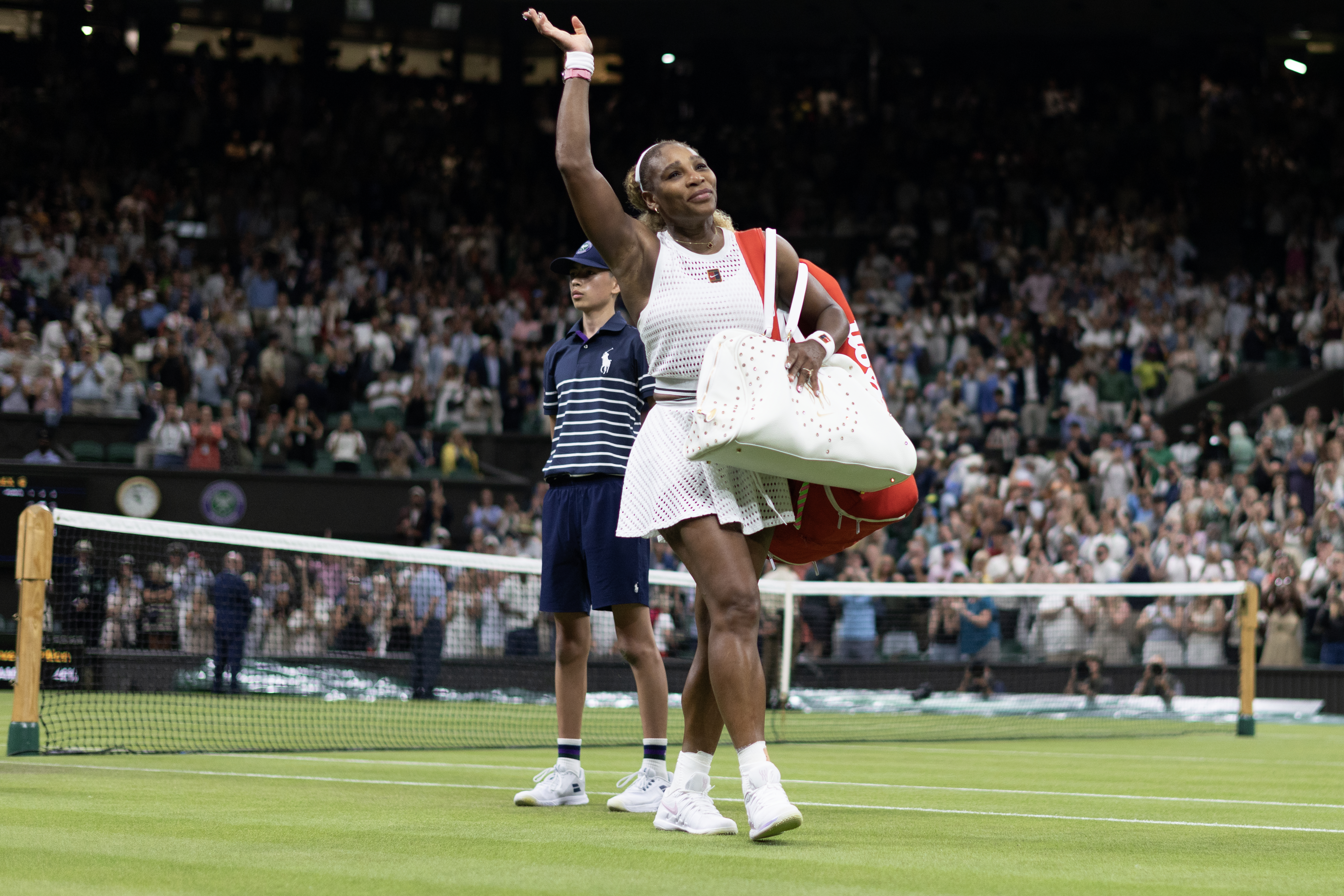
At nearly 45 years old, with her two kids watching from the coaching box, Serena Williams walked down the iconic staircase inside the Wimbledon club house and onto Center Court, headphones locked onto her ears and a nearly blank expression on her face.
Williams, by her own admission, did not come back to professional tennis because she thought she could win titles. But a lifelong competitor of Williams’ quality does not enter this realm just for the applause.
Almost four years after she said goodbye to professional tennis for the first time, Williams was fully locked into the moment and the assignment, as if nothing had changed from the days when she racked up Grand Slam titles at a record-setting pace. If you didn’t know any better, this could have been the 2012 Olympic gold medal match or the 2016 Wimbledon final when she won her seventh title at the All England Club.
It was still Wimbledon, still Serena, and completely surreal.
But this time, maybe for the first time in her tennis life, Williams wasn’t facing an opponent on her favorite court. She was trying to beat the impossible.
She nearly pulled it off.
After 2 hours, 22 minutes of tennis that both breathed life into Williams’ comeback and exposed how much more limited she is four years after we last saw her on a singles court, it was hard to tell whether this was the beginning of a new chapter or an attempt to author a different end.
Maya Joint, who is so young at age 20 that she wasn’t even born for Williams’ first two Wimbledon titles, seemed slightly shocked and significantly relieved when Williams’ final groundstroke landed long of the baseline to finally give her a 6-3, 6-7, 6-3 victory.
But the reality of what unfolded Tuesday wasn’t surprising at all.
Williams, as expected, can still hit aces and can still trade shots from the middle of the court. What she can’t do, at least not with the effectiveness necessary to compete consistently against the best players in the world, is make multiple direction changes within a point. She can’t go for winners to shorten points without making a multitude of errors. She can’t hold up physically deep into a third set against an opponent with younger legs.
Such is Williams’ aura on a tennis court, however, that the mind wonders: Would she have been able to do those things if she had a series of matches under her belt rather than jumping back into competition at Wimbledon? Is she really that far away from being able to win matches at the highest level? With a little more fitness, a little more competition, would she round back into the kind of form that carried her to Grand Slam semifinals in 2020 and 2021?
It might be best for Serena to let the mystery be.
Because here’s another dose of reality: Though it was commendable for Williams to win a set and briefly take a lead in the third with an early break, she was facing the 87th ranked player in the world who had lost 12 out of her previous 13 matches. If Williams wants to continue her comeback as a serious endeavor, there would be far tougher hills to climb.
Credit to Joint, who did not have an easy job Tuesday. Despite the realities of age and lack of competition, nobody in the field wanted to face Williams in the first round simply because of the spectacle and the pressure. Though Joint mostly had the match under control, the stress of trying to close it out at the end of the second set and the beginning of the third set looked like it might be her undoing. Error after error handed Williams a real shot to win and the Center Court crowd an opportunity to will it into existence.
And credit to Williams, who was competitive enough to justify getting a singles wildcard, though it didn’t really need much justification in the first place. For a brief moment, with Joint rattled, the champion in her roared. When Williams broke serve for a 2-1 lead in the third, there was a pathway to victory. It seemed like she might beat the impossible after all.
But the moment proved to be fleeting. A few minutes later, trailing 2-3, an exhausted Williams broke down on a forehand, hit a double fault and got broken at love. Being 44 and playing competitive tennis on this stage is a marvel. It’s also a reality she will fight every time she wants to do this.
That’s the tough part going forward. Williams would probably benefit from more match play, but going back out on tour full time is impractical personally and professionally at this stage of the game. The more she plays, the better she would perform, but the worse her body would hold up. And to what end, if the end isn’t a Grand Slam title?
If Serena continues her comeback to the U.S. Open and beyond, it will probably look a lot like it did Tuesday: A few thrills and a lot of concessions to age, often resulting in losses to players she would have dusted off the court five or six years ago.
If that’s enough for her, it should be enough for the rest of us. When an all-time great athlete is giving the impossible this good of a tussle, it’s always worth a try.
O que achou dessa notícia? Deixe um comentário abaixo e/ou compartilhe em suas redes sociais. Assim conseguiremos informar mais pessoas sobre o que acontece no mundo do tênis!
Convidamos você a clicar em Página de Parceiros para conhecer os parceiros do Tênis Portal e acessar seus sites.
Esta notícia foi originalmente publicada em: Fonte original