

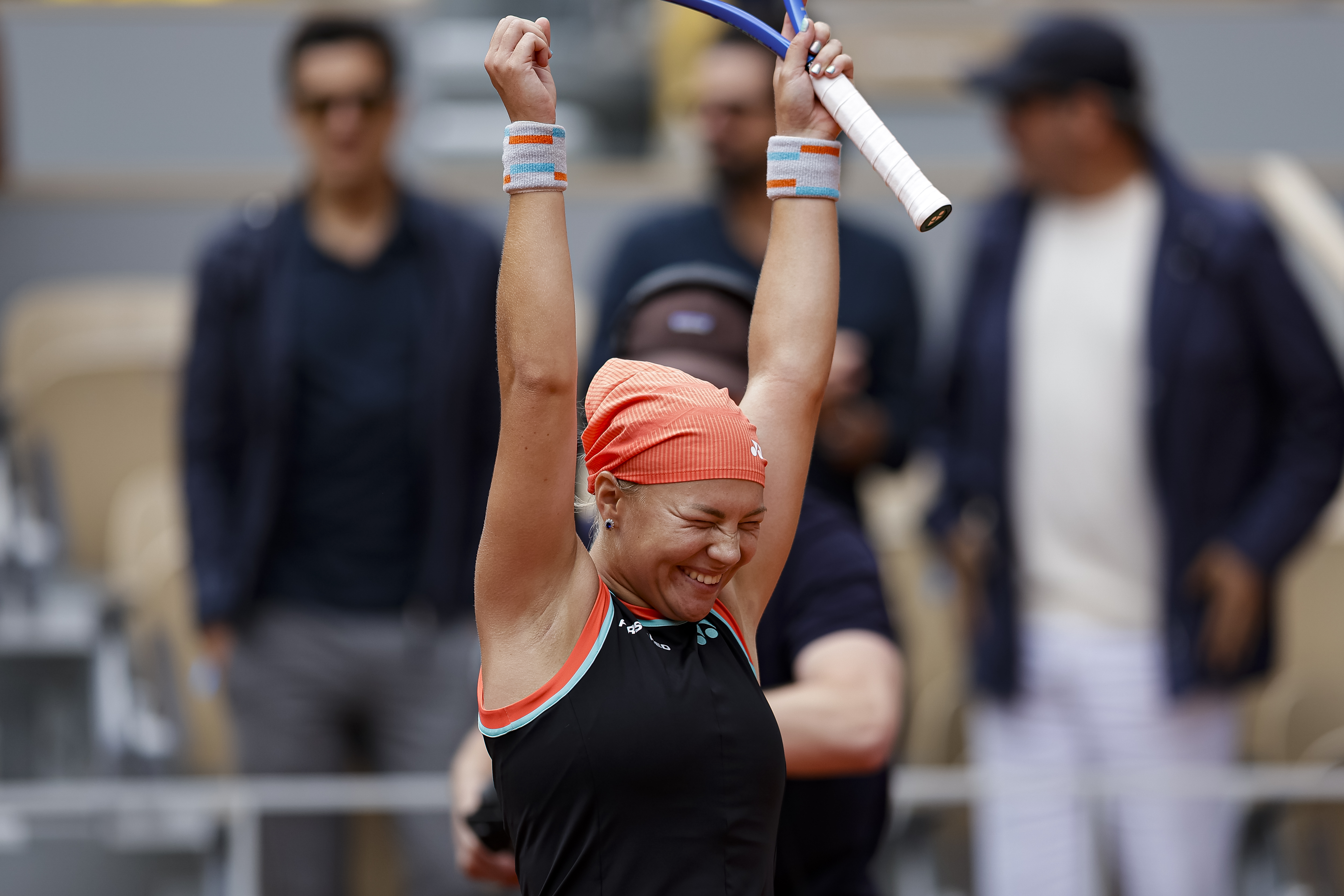
NC State tennis coach Simon Earnshaw’s plans for the weekend changed just a bit Wednesday morning when Diana Shnaider stunned No. 1 seed Aryna Sabalenka to make the French Open semifinals.
“It shouldn’t be that I just show up for the final,” Earnshaw told Yahoo Sports as he was scrambling to get ready for an overnight trip to Paris to watch Shnaider face qualifier Maja Chwalinska on Thursday. “I got kind of nudged by people at school that maybe it would be a good idea to have a presence [at the semifinals] as well.”
Though college tennis has made huge inroads on the ATP Tour in recent years with a high volume of players, led by Ben Shelton and recent Roland Garros quarterfinalist Rafael Jodar making a seamless transition from the NCAA to the pros, women’s tennis is a different beast.
While some notable former collegians like Emma Navarro, Danielle Collins and Jennifer Brady have gone deep in Slams over the last handful of years, the perception has always been that women develop and peak earlier. The path for most top juniors is just going straight to the WTA Tour. College generally isn’t even considered as an option.
Which makes Shnaider’s case an interesting one, particularly at a moment when college tennis has been in the news as a potential chopping block sport for schools whose athletic budgets have been strained by revenue sharing and NIL payments.
Shnaider, a 22-year-old from Russia who came into the French Open ranked No. 23, was one of the top juniors in the world and even won a round in the Australian Open main draw in 2023 before she ever played for the Wolfpack. But much to the surprise of people who thought Shnaider would simply turn pro after getting into the top 100 of the WTA rankings, she went back to Raleigh and helped NC State reach the NCAA final before going out on tour full time.
“I think people are still pretty confused why Diana Shnaider went to college in the first place,” Earnshaw said. “Unlike a lot of recruits right now who are asking for stuff — how much money can you give me or how many events can you take me to or what are the bits and pieces I can get on top of cost of attendance and the Alston money — Diana was always different.
“At a young age she had a very clear idea that she could be a very good player but she felt, to be better than top 200, she had specific things she needed to improve and knew exactly what they were at 17 years old. It was really more a case of going through those and us having a plan of how we were going to tackle those with her and her gaining an understanding that we had the know-how and experience to provide her with that.”
To back up for a moment, Earnshaw chalks up NC State’s recruitment of Shnaider entirely to chance. His assistant coach, David Secker, had previously worked at the Advantage Tennis Academy in Irvine, Calif., where he had developed a relationship with a Russian family living in the U.S. who had a connection to her mother, Yulia.
Play 2026 Soccer Pick ‘Em with FOX One and make your picks for the world’s biggest soccer tournament
At the time, with Shnaider nearing the end of her junior career in 2022, there was a lot of uncertainty by the mere fact of being Russian. The country’s invasion of Ukraine had started. Travel was going to be difficult, and there was not going to be financial support from the national tennis federation.
“They were just looking for a level of stability and something that could help provide her a base,” Earnshaw said. “It was really just looking to have a 12- to 24-month plan to provide her with improvement with her game and she was quite clear that if she got better she felt she could be top-100, if not top-50. So between [Secker], her mom and [their mutual connection], they had conversations which ultimately led us to being on a Zoom with Diana and her mom. At that point she was probably ranked about 800 in the WTA. I wasn’t really sure how serious it was at the time, but they kept kind of coming back and kept sticking with it.”
The conversations continued to the point where Secker flew to Roland Garros in 2022 to meet with Shnaider, who was playing in the junior tournament. Shortly thereafter, she committed to NC State and enrolled in August for the fall semester, but couldn’t play because the NCAA wouldn’t clear her over what Earnshaw described as confusion over the new rules about agent representation coming out of the implementation of NIL.
“Because they didn’t know they just kept saying no,” Earnshaw said. “When you look back at it, it was kind of dumb at the time. But the whole time she was taking classes, training with us and she’d just pop off and play some pro events and that’s where she got high enough to get into the qualifying at the Australian Open.”
Shnaider qualified for the main draw, won her first-round match, and then took No. 6 seed Maria Sakkari deep into the third set in a match that was played during the primetime TV window in the U.S. and broadcast on ESPN. At that point, NC State president Randy Woodson got involved in the eligibility fight at the NCAA level and helped clear the path for her to play in the spring semester.
“That match was quite helpful for us,” Earnshaw said.
Shnaider didn’t stay in Raleigh long, but she did enough to go 20-3 in singles, help NC State win the ACC tournament and be named an All-American in singles and doubles. More importantly, she developed her skill set, checking off boxes she had discussed with Earnshaw, like improving her second serve, moving forward to the net, building a backhand volley that had been nonexistent up to that point and learning how to play doubles.
“Obviously doubles is very important in college, and we’ve done well, so it was an easy sell for us but she said, ‘I know I’m going to need to play doubles early in my career to make inroads with the top players and gain more experience, so I have two chances and can maybe play deeper in the week when I’m younger on the WTA,'” Earnshaw said. “If you asked her she’d tell you we were able to provide her with help in all those areas and that was a huge positive for her and also for us.
“She chose to take what would be a different pathway for an Eastern European, but it would be hard to say it hasn’t worked for her.”
At this point, Shnaider has a real chance to win the French Open. Though she hasn’t been this far in a Grand Slam, she has five WTA titles on her résumé and will be favored Friday against Chwalinska. If she takes home the trophy, she’d be the first former college tennis player on the women’s side to win a singles Grand Slam since former Stanford All-American Barbara Jordan took home the Australian Open in 1979.
At a time when college tennis seems under siege — Saint Louis and Arkansas recently announced they were dropping their programs before the Razorbacks reversed course under donor pressure — it’s a powerful statement about the impact it can have on the world stage.
“I think it’s taking these kids longer and longer to mature for whatever reason right now,” Earnshaw said. “I don’t think it’s their fault but there’s sort of become this gap between junior tennis moreso, and what we see with professional tennis and college tennis was kind of in that gap. Because that gap has gotten bigger, we fit the gap better now.”
O que achou dessa notícia? Deixe um comentário abaixo e/ou compartilhe em suas redes sociais. Assim conseguiremos informar mais pessoas sobre o que acontece no mundo do tênis!
Esta notícia foi originalmente publicada em:
Fonte original