
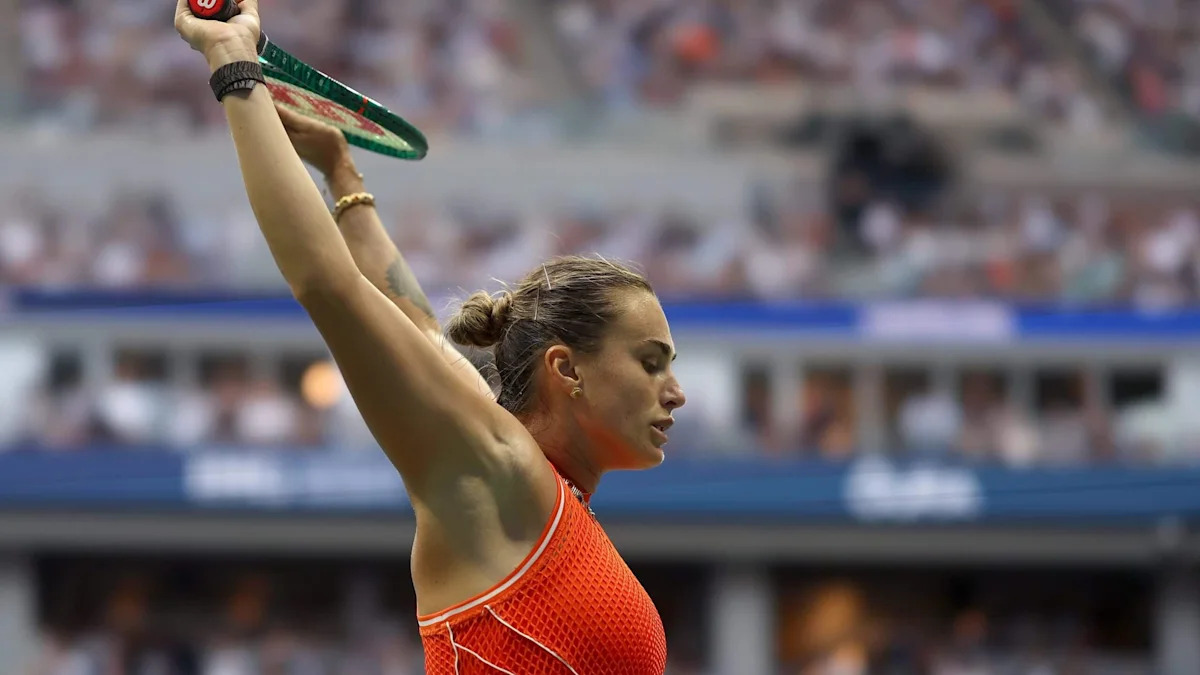
INDIAN WELLS, Calif. — Aryna Sabalenka gathered her things and drove off into the California sunset after one more confounding loss Friday, this one her last of 2026.
She had no desire to discuss the match, a 6-3, 3-6, 6-1 loss to Elina Svitolina that knocked her out of the WTA Finals, or reflect on a season that fell far short of her usual standard. She declined to do post-match media.
It was an abrupt end to a season, and perhaps an era, that devolved slowly.
In hindsight, Sabalenka’s 2025 and 2026 look like years of missed opportunity after she stood so securely at the top of the women’s game in 2024.
That was when she clinched the year-end world No. 1 ranking for the first time, after winning the U.S. Open and Australian Open. She also claimed the WTA 1000 Wuhan and Cincinnati Opens that year, before winning four more trophies in 2025, including another U.S. Open.
With Iga Świątek’s steady drumbeat of Grand Slams slowing to a trickle — the Pole won five between 2020 and 2022 before claiming her sixth, at Wimbledon, in 2025 — Sabalenka had the chance to overtake Świątek at the top of the group that has led women’s tennis for the past half decade.
Instead, she has now gone 1-5 in major finals since the start of 2025, with that triumph over Amanda Anisimova in New York her only victory. She also lost last year’s WTA Finals championship match to Elena Rybakina.
Rybakina, who dethroned Sabalenka to take the top spot in the rankings during this year’s U.S. Open and then beat her in the final for good measure, has three Grand Slam titles to Sabalenka’s four and is in good position to gain even more ground. 19-year-old Mirra Andreeva, this year’s French Open champion, has overtaken her as world No. 2. Coco Gauff is getting closer to retooling her weapons and Świątek is showing ominous signs of resurgence.
Sabalenka has the offseason to start finding some answers. She started the process early, recently splitting with one of her two coaches, Max Mirnyi, who joined longtime coach Anton Dubrov as a secondary voice on her team ahead of the U.S. Open in 2025. She changed hitting partners around the middle of the year and has a new physio.
She was coy this week when asked if she’d be looking to add another coach, answering only, “We’ll see,” during a mixed zone interview.
“For now, there is some changes in my team,” she said. “Hopefully, for better future.”
Rybakina withdrew from the WTA Finals on the eve of the tournament with a viral illness, but when healthy, her game has looked steadier than Sabalenka’s this season. She this year collected four titles, including two Grand Slam trophies, commanding the hard courts with her big serve and devastating groundstrokes.
For a time at the start of 2026, it looked as though Rybakina and Sabalenka might lead this year in women’s tennis together.
After Rybakina won their Australian Open final, the Belarusian looked like a freight train and won the Sunshine Double — the BNP Paribas Open and Miami Open — in March. In the final of the former, she defeated Rybakina in one of the matches of the year, saving a match point. But the trouble began on clay at the Madrid Open, when she snapped a 15-match win streak by losing to then-No. 32 Hailey Baptiste, who saved six match points.
The losses twisted out of control from there. Sabalenka ends 2026 with a 48-13 record, but 26 of the wins came before the defeat to Baptiste. Since that match, she is 22-11.
She was a game away from victory over Diana Shnaider in the French Open quarterfinals before losing her cool in the Paris wind for the second year in a row. She looked lackluster and confused against a confident Naomi Osaka at Wimbledon, then tired and angry as she watched leads in the first set and a second-set tiebreak slip away against the indefatigable, speedy Sára Bejlek at the Cincinnati Open.
Rybakina overwhelmed Sabalenka at the U.S. Open. She saved nine match points at the Wuhan Open against world No. 31 Ann Li before the American wore her down.
Friday’s match against Svitolina was Sabalenka’s first loss to the Ukrainian in six years and her second in eight career meetings. She had never lost to her on a hard court. More startling than the outcome was how shaken Sabalenka looked, her fundamentals not spiraling out of control, but just malfunctioning consistently.
She led by a break of serve in the first and third sets, but won neither. Svitolina won the last six games of the third set.
The 32-year-old Ukrainian also won six of her eight break points and had the space and time to produce some fantastic, line-clipping shots because of how lost Sabalenka appeared on court, outside of the second set. She tried to end points too soon. Her footwork was either slow or imprecise. She over-rotated and overshot on her forehand.
“She gave me a few chances here and there so I could find my shots,” Svitolina said during her on-court interview.
When Sabalenka reemerges in the new year, the landscape will have shifted, with Rybakina at the top of women’s tennis. Świątek, who changed coaches in March, is months ahead of Sabalenka in addressing the problems that have ailed her game. Amid those lost major finals, Sabalenka and her team have developed a playbook for rebounding from Grand Slam heartache, but their next body of work will need to be more comprehensive.
The 28-year-old often speaks of her consistency as one of the greatest achievements in her career. She spent 99 weeks fending off worthy challengers to maintain her No. 1 ranking.
She has a new, perhaps more arduous, challenge ahead now: getting back to the top.
This article originally appeared in The Athletic.
Tennis, Women’s Tennis
2026 The Athletic Media Company
O que achou dessa notícia? Deixe um comentário abaixo e/ou compartilhe em suas redes sociais. Assim conseguiremos informar mais pessoas sobre o que acontece no mundo do tênis!
Convidamos você a clicar em Página de Parceiros para conhecer os parceiros do Tênis Portal e acessar seus sites.
Esta notícia foi originalmente publicada em: Fonte original