

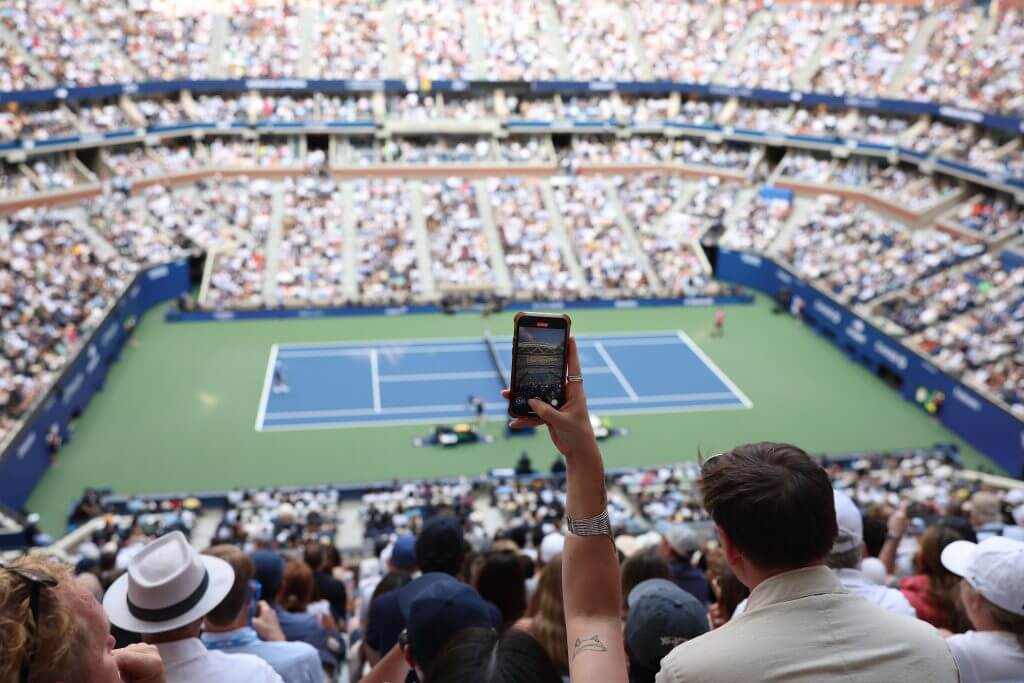
 There’s one question that every type of U.S. Open fan is asking, from die-hard tennis wonks to executives who control corporate entertainment expenses:
What’s up with these ticket prices?
A quick glance at the fourth Grand Slam of the year’s website this week reveals sobering numbers for the first big day of action on Monday, Aug. 31.
A grounds pass with no guaranteed seat on any court — stadium or otherwise — is going for over $360. The face value is $65.
An upper-deck seat in Arthur Ashe Stadium costs $326.
Want to sit in the lower section in the biggest stadium on the grounds that day, which will provide an up-close view of some (possibly) one-sided matches, as well as access to general admission seats on the rest of the courts? That’s $518.
Row Z in the promenade level of Arthur Ashe — the highest level of the stadium — that day is $454. A seat in the area even closer to courtside than the $518 seats is $2,104. A seat in the loge section, about halfway up the stadium, above the ring of luxury suites, is $1,236.07.
U.S. Open secondary market prices
for Aug. 31 at Arthur Ashe Stadium
Promenade
$454
Courtside
Non-club: $2,104
Club: $3,786.25
Loge
$1,236.07
U.S. Open secondary market prices for Aug. 31
at Arthur Ashe Stadium
Promenade
$454
Courtside
Non-club: $2,104
Club: $3,786.25
Loge
$1,236.07
Highest price on Ticketmaster as of Aug. 19.
There is some price relief in the other stadiums, and fans who are willing to wait out the day can usually get into the grounds at 6 p.m for $25 and stay all night.
Regardless, this doesn’t seem like a tournament in a public park, played on public courts and run by a non-profit organization with a mission to increase accessibility to tennis and grow the game nationwide.
“Our vision is to be the most inspirational and captivating sports entertainment event in the world by delivering world-class experiences for our fans, partners, and players to fuel the mission of the USTA, so accessibility is at the core of the beginning of the strategy,” said Kirsten Corio, the chief commercial officer for the United States Tennis Association.
She cited the less expensive and free access the USTA provides during the qualifying tournament, mixed doubles and exhibition nights before the singles tournaments as central to that effort, given that 240,000 people last year attended what the U.S. Open calls Fan Week.
“You could see Djokovic on Arthur Ashe playing a practice match against another top-10 player for free in the first row,” she said. “That’s like no other sport that I can think of.”
The surging prices at this year’s U.S. Open are driven by the convergence of factors both within and outside the tournament’s control.
As tennis has found a groove at the intersection of media, celebrity, sports, culture and high fashion, the popularity of live events has increased in the wake of the Covid-19 pandemic. Sports events such as the U.S. Open have assumed the status of a superstar’s concert, and for many years, a rampant resale market has taken advantage of that popularity.
The organizers of those events are also recognizing their own lucrativeness. And for the U.S. Open, 2026 is the first year in which that dynamic has aligned with the tournament’s immediate concerns.
Arthur Ashe Stadium, the highest-capacity arena in tennis, is halfway through an $800 million renovation, which will reconfigure it toward the premium hospitality that the USTA says its most moneyed customers demand. At the same time, top players are seeking reforms that will mean that their prize money takes up a bigger proportion of the Grand Slam tournaments’ revenues. And if the organizers of those tournaments want to honor that prize-money increase for the players while keeping the same margins, something has to get more expensive.
Right now, that thing is sitting on the tournament’s biggest court.
The price increases and unchecked resale market are causing frustration among fans of all ages, who feel priced out of an event that they are told they are making culturally meaningful, whether to roam the grounds or to watch the starriest matches of the day.
In the weeks and months leading up to late May, the USTA sold most of its higher-priced tickets to its subscribers and corporate customers. Many of them commit to buying the same tickets for all 27 sessions throughout the 15-day event. They renewed at a rate of nearly 100 percent.
Then the organization released the remaining tickets to the open market at face value. The vast majority, including grounds passes, sold out very quickly, despite prices increasing compared to 2025. Most of what is available on the U.S. Open website now is resale inventory, whether from those subscribers or from people who snapped up face-value tickets, some using bots and other scrapers to harvest inventory.
Deep-pocketed New Yorkers and resellers long ago figured out they could turn attending the season’s final Grand Slam into a profitable experience.
The USTA does not control what sellers ask or what buyers pay, though its contract with Ticketmaster allows the USTA a small commission on the resale of tickets. The other three majors have guardrails in place, from enforcing resales at face value to not permitting them at all.
Face value and resale prices
at the 2026 U.S. Open
face
value
Avg. resale on
ticketmaster
Ticket area
Diff.
Ground pass
$65
$263
+305%
Promenade
$118
$382
+224%
Loge
$241
$569
+136%
Courtside (non-club)
$563
$715
+27%
Courtside (club)
$2,333
$2,621
+12%
Face value and resale prices at the 2026 U.S. Open
face
value
Avg. resale on
ticketmaster
Ticket area
Difference
Ground pass
$65
$263
+305%
Promenade
$118
$382
+224%
Loge
$241
$569
+136%
Courtside (non-club)
$563
$715
+27%
Courtside (club)
$2,333
$2,621
+12%
Face value comes from dividing the average price of the full series subscription by the 27 sessions included in the subscription. Ticketmaster figures are the average of resale prices for Aug. 31 for each ticket area, as of Aug. 19.
The tournament — which is now nearly three weeks long — has become one of those New York City happenings where so many models, actors, media moguls, sports figures, pop stars and others want to be and be seen that just about any price will be paid by somebody. Everyone seemingly watches them — and a little tennis — with a $23 Honey Deuce in one hand, swaying to DJ Trizz’s mixes on the sound system. The popularity of grounds passes has the side-effect of making them less empowering, as more and more people compete for the same number of seats on outside courts — and for any kind of vantage point to watch tennis.
The recreational popularity of tennis surged in the wake of the Covid-19 pandemic. Millions of Americans rediscovered the sport during the time of social distancing, when vast, bored segments of the population yearned for outdoor activities.
When the pandemic eased, USTA data showed that tennis participation rocketed to more than 27 million players — a number not seen since the tennis boom of the 1970s and early 1980s. As recently as 2019, there were just 17.7 million players in the U.S., according to a report from the Physical Activity Council and the USTA.
The demand for tickets to other live events has boomed as well. Concert tickets for pop stars fetch several hundred dollars for seats in the upper reaches of massive football stadiums. A balcony seat for Hamilton on Broadway is more than $200. An NBA game will run over $300.
By comparison, a day at the U.S. Open begins at 11 a.m. and can last well into the night. On a cost-per-hour basis, tennis executives would argue that the tickets are a bargain.
They would say they provide opportunities for people of modest means to get their hands on reasonably priced tickets and give those fans a high-quality experience.
Once those tickets get purchased, though, the market takes over. Prices might come down as the tournament gets closer and the possibility that a ticket might go unsold approaches. But they might not.
“We knew that we would be leaving dollars on the table,” said Corio, the chief commercial officer. “The market has spoken and has demonstrated that we have.”
But tell that to a family that has to pay $1,500 to bring four people to the Billie Jean King National Tennis Center for the day, or the young professional whose monthly outgoings make a day of tennis that starts — before transport, drinks, food and other purchases — at over $350 out of reach.
While the grounds pass is the banner example of surging prices, in sports, the seats closest to the action have the highest demand because there are so few of them. They’re like beachfront property. Events can’t make more of them.
Except the USTA has figured out that it can — in the stadium where it happens.
This year’s U.S. Open is the first to take place during the $800 million renovation of Arthur Ashe Stadium.
That renovation has reconfigured the seating to create more of the most expensive seats, as well as adding nine new hospitality clubs before next year. It also includes the construction of a $250 million player training and hospitality center.
This is hardly an act of benevolence. The USTA had to move the current player training and lounge areas and the locker rooms out of Arthur Ashe Stadium to make way for new hospitality clubs, which justified the higher ticket prices for courtside seats and luxury suites.
“There’s no question that there’s a lot of money to be made from the courtside seats and the suites to help fund everything else that we’re doing,” said Daniel Zausner, the chief operating officer of the National Tennis Center in Flushing Meadows.
“You know how well our tickets sell.”
Before the renovation, there were about 2,800 seats in the lowest portion of the stadium, the courtside area. Then came a level of luxury suites. Then a middle section, called the loge, which had about 6,000 seats. Above that was an upper tier with about 13,500 seats.
During the past 10 months, construction workers and engineers have ripped out everything below the upper tier and reconfigured the stadium.
Now, there are 5,000 seats in the lower courtside area, including 2,000 club seats, with access to exclusive hospitality areas. Three temporary clubs will be open this year, with six more opening next year.
On the next level, there is the ring of luxury corporate suites. Above the suites is a vastly reduced loge section of about 2,500 seats. Then comes the upper tier, known as the promenade, which stretches up into the nosebleeds.
Arthur Ashe Stadium renovation
What’s new
Courtside
Added 2,200 seats, including 2,000 club
seats.
Loge
Reduce from 6,000 to 2,500 seats.
Arthur Ashe Stadium renovation
What’s new
Courtside
Added 2,200 seats, including 2,000 club seats.
Loge
Reduce from 6,000 to 2,500 seats.
Here’s where the math gets very good for the USTA.
Last year, the 6,000-seat loge section in the middle of the stadium had an average ticket price of $291 per session. The renovation took out 3,500 of those seats.
Those seats have effectively been replaced one-for-one by seats in the courtside area, where the average price for a seat without food-and-drink service is more than $560 per session. Seats with hospitality in that section cost more than $2,300 per session. Even before factoring those in, that’s nearly a 2x increase in price on 3,500 seats, created out of thin air and a lot of concrete.
Furthermore, about 75 percent of those 6,000 seats in the loge section belonged to subscribers. For years, many of those subscribers told Corio and their team that they wanted to move their subscriptions down to the courtside section. They couldn’t, because seats there never became available.
Now the USTA has created those seats, and subscribers have paid for them.
“The pricing reflected what we felt was fair for the significantly upgraded seat,” Corio said.
The upper-tier seating hasn’t changed. During the next year, the USTA will expand that concourse and add a rooftop bar.
Face-value ticket prices for the 13,500 seats in the promenade level are, on average, $117 per session this year, compared with $113 last year. The least expensive, non-weekend, day-session grounds passes cost $65. But those tickets are showing the highest markup rate on the secondary market, with prices roughly four to five times their face value.
The USTA insists it is still running an accessible event. Its Fan Week, which includes the seven days before the start of the main draw, when the qualifying competition and the mixed doubles tournament take place and the best players are practicing, remains largely free.
Tickets to mixed doubles matches on Ashe cost money, but the matches on Louis Armstrong Stadium will remain free — for now.
“We have enough demand that we could charge a ticket price for Fan Week, but we don’t,” Corio said.
But Fan Week is not the U.S. Open, at least not the one that people who want to experience the sport across all demographics, from age and sociocultural background to wealth, want to visit. As the resale market and the changes to its main stadium converge, sentiment against the prices is rising — but the tickets keep on selling.
Tennis is a game of capitalizing on opportunities when they arise. At the moment, so too is the game of running the U.S. Open.
This article originally appeared in The Athletic.
Sports Business, Culture, Tennis, Women’s Tennis
2026 The Athletic Media Company
O que achou dessa notícia? Deixe um comentário abaixo e/ou compartilhe em suas redes sociais. Assim conseguiremos informar mais pessoas sobre o que acontece no mundo do tênis!
Convidamos você a clicar em Página de Parceiros para conhecer os parceiros do Tênis Portal e acessar seus sites.
Esta notícia foi originalmente publicada em: Fonte original