

In this article, Timo Schwarzmeier shows why mental strength in tennis is often more important than perfect technique and how you can train it deliberately. You’ll learn practical tennis mental training methods to stay focused under pressure, recover from mistakes faster, and play more consistently in matches. Expect concrete exercises, routines, and strategies you can apply immediately in practice and competition.
Table of Contents
1. Introduction: Why Mental Training in Tennis Is Essential
Tennis mental training is no longer a “nice-to-have” — it’s a decisive performance factor. Many recreational tennis players train their technique intensively, but without targeted mental training, their potential often remains unused in matches. This is exactly where mental training in tennis comes in: it helps you keep existing skills stable under pressure and bring them to the court when it matters.
Whether it’s nervousness on serve, overthinking on break points, or frustration after easy mistakes, mental processes influence every decision and every shot. Anyone who systematically trains their mental strength in tennis plays more consistently, makes better decisions, and remains capable of acting even in critical moments.
1.1 The Importance of Mental Strength in Modern Tennis
Tennis is one of the most mentally demanding sports. Long and sometimes intense rallies, short breaks, constantly changing situations, and the ongoing comparison with an opponent require a high level of concentration and self-regulation. Mental strength in tennis does not mean staying calm at all times — it means dealing constructively with emotions, pressure, and uncertainty.
In today’s game, mental strength often decides victory or defeat, especially at the recreational and amateur levels. Differences in performance are rarely purely technical; more often they come down to the ability to keep focus high, process setbacks quickly, and think clearly and structurally even at tight scores. Tennis mental training builds exactly these foundations.
1.2 Studies & Insights on Mental Performance in Tennis
Sports science findings show that mental factors have a significant impact on tennis performance. Concentration, emotional control, and confidence influence not only shot quality, but also reaction time, decision-making, and movement coordination. Under pressure, performance typically drops — unless a player has trained mental strategies.
For mental training in tennis, that means: mental skills are trainable, just like the forehand, backhand, and serve. Players who work deliberately on their mental performance can regulate stress better, stay more focused, and make the right decisions more often in matches — even in critical situations.
1.3 Typical Mental Challenges for Tennis Players
Recreational tennis players repeatedly face similar mental problems in matches:
- Nervousness at the start of a match and on important points
- Performance drop under pressure, e.g., on break points or set points
- Negative self-talk after mistakes
- Anger and frustration that repeatedly disrupt flow
- Loss of focus after falling behind or after easy errors
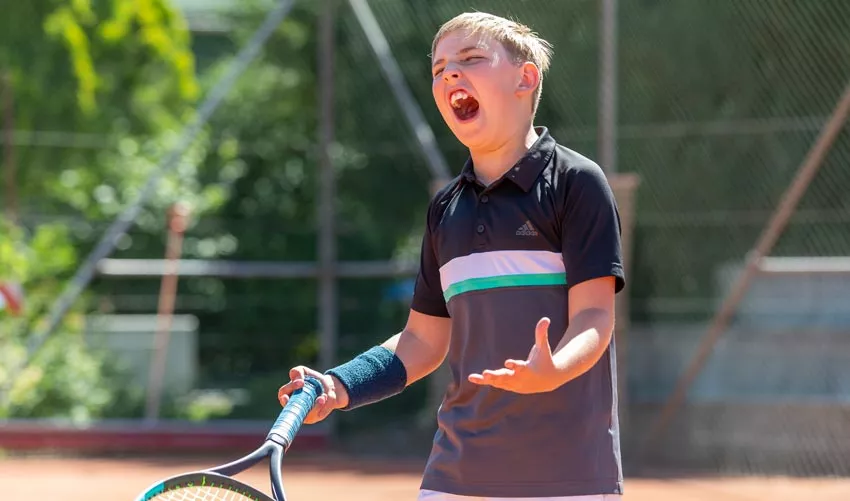
These challenges have nothing to do with a lack of talent. They are the result of missing mental routines and strategies. This is exactly where mental training in tennis helps: it supports you in recognizing typical mental patterns, managing them, and changing them sustainably.
In the next section, we clarify what tennis mental training actually is, how it differs from physical training, and why it can make a huge difference especially for recreational players.
2. Definition & Foundations of Mental Training in Tennis
Tennis mental training refers to the systematic training of mental skills that enable tennis players to reliably access their performance under match conditions. It’s not just about motivation or positive thinking, but about clearly defined, trainable competencies such as focus, self-regulation, emotional control, and decision-making under pressure.
While technique and fitness training create the physical prerequisites, tennis mental training ensures these skills are not blocked in competition but can be executed reliably. In tennis — a sport without a coach on the court — this ability is crucial.
2.1 The Difference Between Physical Training and Mental Training in Tennis
Physical tennis training is visible: strokes, footwork, repetitions, workload, and so on. Mental training, by contrast, is invisible — yet it influences every movement, every shot, and every decision.
A simple comparison:
- Physical training improves what you can do.
- Mental training in tennis determines whether you can access it in a match.
Many recreational players experience this gap: shots are stable in practice, but errors increase in matches. The cause is rarely technique — it’s mental factors such as nervousness, expectation pressure, or missing routines. Mental strength in tennis acts as the link between training and competition.
2.2 Core Principles of Tennis Mental Training
Sound mental training in tennis is based on several key principles that interact and jointly determine mental performance:
- Focus and attention control: Tennis requires the ability to direct focus to the next point, the next shot, the current task. Mental training teaches you to block irrelevant thoughts and steer attention deliberately.
- Confidence and inner stability: Confidence in tennis does not come from wins, but from trusting your ability to act — especially after mistakes. Mental training strengthens this inner stability regardless of the score.
- Resilience and mistake processing: Errors are unavoidable. What matters is not the mistake, but your response. Tennis mental training provides strategies to process setbacks quickly and stay capable of acting.
- Emotional control under pressure: Anger, frustration, or fear cost energy and focus. Mental strength means noticing emotions without being controlled by them — especially in tight phases.
These principles form the basis of sustainable mental development in tennis.
2.3 Why Mental Training Is Especially Relevant for Recreational Players
Recreational players often underestimate the impact of mental factors — yet they are often more affected than professionals. The reason: pros train mental skills for years (consciously or unconsciously), while recreational players usually focus only on technique.
Typical conditions in recreational tennis include:
- Few matches with high importance
- Irregular competition experience
- High expectation pressure (team, league, personal goals)
Under these conditions, mental strength often matters more than technique or fitness. Structured mental training helps recreational players access their existing skills consistently instead of “playing against themselves” in matches.
In the next section, we analyze the most common mental problems in tennis, why they occur, and why they keep showing up even in experienced players.
3. The Most Common Mental Problems in Tennis — and Why They Occur
Mental problems in tennis are not a sign of weakness, but a logical reaction to pressure, uncertainty, and expectations. Almost every recreational player knows situations where their game suddenly becomes unstable even though the technique is there. To use mental training in tennis effectively, it’s essential to understand why these problems arise.
3.1 Match Anxiety and Nervousness in Tennis
Nervousness before or during a match is one of the most common mental problems. It shows up as tense movements, restless thoughts, or noticeably reduced tempo. The cause is usually an overvaluation of the situation: the match feels like an exam rather than a task.
For many recreational players, every league match is emotionally charged — due to team pressure, ranking points, or personal expectations. Without mental strategies, the nervous system reacts with tension. Mental training in tennis helps regulate this response and turn nervousness into manageable activation.
3.2 Pressure in Decisive Moments (Break Point, Tiebreak, Match Point)
Decisive points change your internal focus. Instead of concentrating on the task, thoughts drift toward the outcome: What happens if I win or lose now? This outcome focus increases pressure and disrupts automated movement patterns.
Typical consequences:
- “Safety balls” without clear commitment
- Passive instead of proactive play
- Rushed errors
Mental strength shows up exactly here: in handling pressure moments. Through targeted mental training, players learn to shift focus back to controllable processes — regardless of the score.
3.3 Negative Self-Talk and Mental Blocks
Thoughts like “Same mistake again” or “I can’t do this” are more powerful than many realize. Negative self-talk influences posture, preparation, and decision quality. When these patterns repeat, mental blocks develop.
These blocks are rarely technical. They arise from:
- Earlier negative match experiences
- Fear of repeating mistakes
- Missing post-error routines
A core goal of mental training in tennis is to recognize these inner dialogues, manage them, and replace them with functional thoughts.
3.4 Anger, Frustration, and Emotional Loss of Control
Anger and frustration are among the most intense match emotions. They often arise when the gap between expectations and reality becomes too large. Players know they could play better and react emotionally when it doesn’t work.
The problem: emotional outbursts cost focus, energy, and time. They intensify error chains and prevent constructive adjustments. Emotional control does not mean suppressing feelings, but regulating them quickly and becoming action-capable again.
Mental training provides exactly this skill: notice emotions, accept them, and deliberately return to the playing process.
Next, we get practical: you’ll learn the 7 most important mental training techniques for tennis — structured, hands-on, and usable immediately in matches.
4. The 7 Most Important Techniques in Tennis Mental Training
Mental training in tennis only works when it is concrete, trainable, and match-ready. The following seven techniques form the foundation of effective tennis mental training. They are practical, can be integrated into practice and matches, and address the exact challenges recreational players face again and again.
4.1 Visualization & Mental Match Priming
Visualization is more than positive imagining. In tennis mental training, it means mentally pre-activating specific match situations: serving on break point, returning at 30–30, a long rally in a pressure phase, and so on.
When applied correctly, visualization:
- activates the same neural networks as real movement,
- increases action confidence,
- reduces uncertainty in unfamiliar situations.
Mental match priming means going through typical scenes before the match, including emotions, tempo, and decision-making. That way, the situation feels “familiar” in the match — a key factor of mental strength.
4.2 Breathing & Regulating the Nervous System
Under pressure, the nervous system becomes more activated: heart rate rises, breathing becomes shallow, movements tighten. A targeted breathing technique is the fastest tool to regulate this state.
In tennis mental training, breathing is used to:
- lower or raise activation,
- bring focus back,
- restart between points.
Consistency is key: breathing techniques must be automated in practice so they work reliably in matches.

4.3 Between-Point Routines
Routines are a central element of mental stability. They structure the time between points and prevent mental drifting. Many pros use fixed sequences; the best-known example is Rafael Nadal’s consistent between-point routine, which he used throughout his highly successful career.
For recreational players:
- routines create mental order,
- reduce outcome thinking,
- and provide security in pressure situations.
A good routine combines breathing, a focus cue (a short trigger word), and a clear decision for the next point.
4.4 Cognitive Reframing: Constructive Handling of Mistakes
Mistakes are unavoidable in tennis. What matters is not the error itself, but your interpretation. Cognitive reframing means deliberately reclassifying an error instead of judging it emotionally.
Examples:
- “Mistake = information” instead of “Mistake = problem”
- focus on adjustment instead of self-criticism
In tennis mental training, players learn to accept mistakes as part of the process and quickly return to “play mode.” This prevents negative spirals and stabilizes performance.
4.5 Attention Steering & Focus Exercises in Matches
Focus is not a permanent state — it’s a controllable process. Mental strength means steering attention deliberately:
- narrowing it (e.g., on serve),
- widening it (e.g., between points),
- resetting it consciously.
Focus exercises help block external distractions (opponent, spectators, score) and keep attention on the next task.
4.6 Self-Talk & Mental Language
Your inner language influences posture, tension, and decision quality. Uncontrolled self-talk is often performance-reducing. The goal is to develop functional inner language.
Effective are:
- short, clear action cues,
- action-oriented statements,
- emotion-neutral wording.
The priority is not motivation, but orientation.
4.7 Goal Setting in Tennis: Process Goals Instead of Outcome Goals
Outcome goals increase pressure because they are not fully controllable. Process goals direct focus to concrete tasks the player can control.
Examples of process goals:
- clear preparation,
- brave decisions,
- consistent routines.
Mental strength grows when players define success through processes — regardless of the score.
Next, we look at mental match preparation: how to set yourself up so focus, confidence, and clarity are present from the start.
5. Mental Match Preparation in Tennis: Start with the Right Mindset
A structured mental preparation often decides how stable you start a match. Many recreational players begin either too nervous or too unfocused — not because they are physically unprepared, but because the mental “entry” is missing. Mental training in tennis synchronizes body and mind for competition.
The goal is to set activation level, focus, and expectations so you can act effectively from the first game — independent of opponent, venue, or match importance.

5.1 Pre-Match Routines for Mental Stability
Pre-match routines create security. They tell your nervous system: I am prepared. A functional routine has the same structure whether it’s a league match, tournament, or practice match.
Typical elements:
- a short breathing sequence to steer activation
- a focus cue (e.g., “calm – clear – brave”)
- conscious alignment to your first match tasks
Crucially, routines must not depend on the opponent or external conditions. They serve your stability only and are a key part of effective tennis mental training.
5.2 A Mental Warm-Up for Mind and Body
A physical warm-up without a mental counterpart is incomplete. A mental warm-up means actively preparing your mind for tempo, decisions, and stress reactions.
An effective mental warm-up includes:
- brief visualization of typical match situations
- conscious awareness of breathing and body tension
- clear alignment to your game plan
This eases the transition from daily life into competition. Mental strength often shows already in the first games, not only later in the match.
5.3 Dealing with Opponent Analysis and Expectation Pressure
Opponent analysis can help — or create additional pressure. Many recreational players get stuck in thoughts like “He’s ranked higher” or “I have to beat her.” Such evaluations shift focus away from your task.
Mental training provides a clear rule:
- Analysis serves orientation — not evaluation.
- Expectation pressure comes from outcome thinking — not from the opponent.
A good mental preparation therefore ends with one clear question: What can I influence in the next point?
Next is the heart of every match: mental strategies during play to stay focused, calm, and decisive under pressure.
6. Mental Strategies During the Tennis Match
In matches, mental strategies are truly tested. Unlike practice, there are no corrections from the outside. Every decision matters. Mental training in tennis gives players tools to stay clear, calm, and capable under pressure.
The goal is not to play error-free, but to navigate changing phases with mental stability.

6.1 Point-by-Point Strategy in Tennis
The point-by-point strategy is one of the most effective mental approaches in tennis. It prevents outcome thinking and reduces pressure by keeping focus on the next task.
Core idea:
- Past (the last mistake) is irrelevant
- Future (winning the match) is not controllable
- Only the next point matters
Mental strength means deliberately restoring this focus again and again — especially after emotional moments.
6.2 Handling Deficits and Difficult Match Phases
Falling behind is part of every match. What matters is not the score, but your mental response. Many players unconsciously change their game when trailing — becoming passive, hectic, or taking uncontrolled risks.
Proven strategies when trailing:
- return to clear process goals
- simplify decisions
- stabilize rather than immediately “flip” the result
Tennis mental training helps you accept deficits as part of the game and respond structurally — without emotional short-circuits.
6.3 Recognizing and Using Momentum Shifts
Momentum describes phases where a match turns. These shifts are often mentally driven. A lost service game, a hard-fought point, or a brief lapse in focus can change dynamics.
Mental strong players:
- recognize momentum shifts early,
- respond with deliberate tempo control,
- stabilize themselves through routines.
Mental training sharpens this awareness — not to force momentum, but to prevent it from working against you.
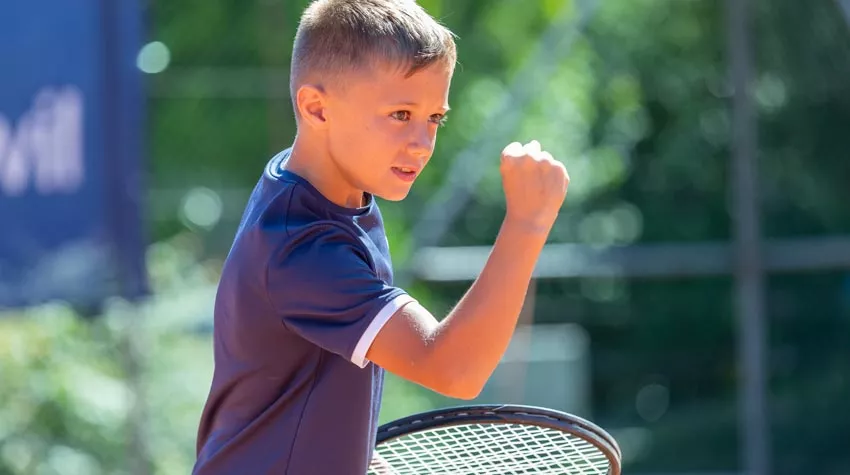
6.4 Real-Time Stress Reduction During Play
Stress can’t be avoided in matches, but it can be managed. Real-time stress reduction means returning to an action-capable state within seconds.
Proven tools:
- short breathing sequences between points
- conscious regulation of body tension
- clear focus cues
These micro-strategies often decide whether a player stays stable in tight moments or loses the thread.
Next, a frequently underestimated area: mental post-match review. You’ll learn how to analyze matches without blocking yourself — and build long-term mental strength.
7. Mental Post-Match Review: Error Analysis Without Self-Criticism
Mental strength develops not only during matches, but especially after them. How players reflect on their performance determines whether they grow mentally or fall back into the same patterns. Mental training uses post-match review as a learning phase — not a judgment.
The goal is to gain insights without losing confidence.
7.1 Effective Match Analysis Instead of Outcome Thinking
Many recreational players judge a match only by the result. That’s understandable — but mentally unhelpful. A win can hide weaknesses; a loss can be judged unnecessarily harshly.
A constructive match analysis focuses on:
- decision quality under pressure
- implementation of your routines
- responses to mistakes and deficits
The result provides information — but not an explanation. Mental strength grows when players learn how they played, not only how it ended.
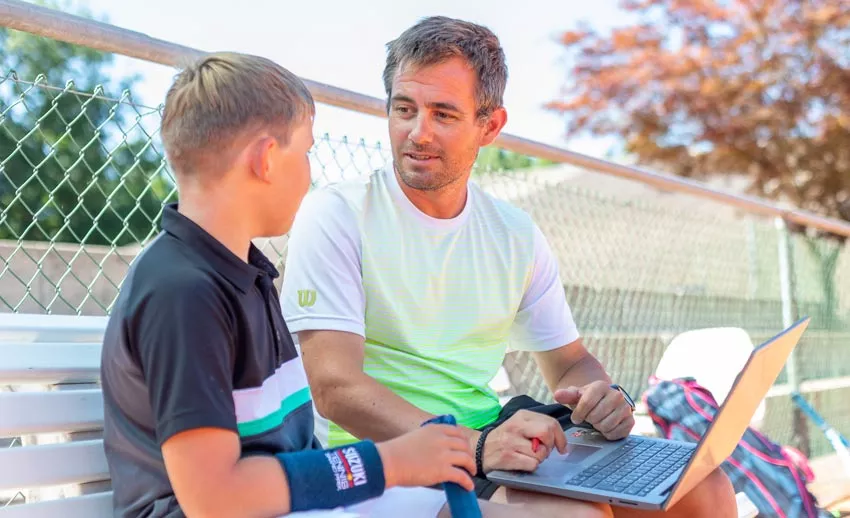
7.2 Journaling and Mental Training Logs
Journaling is a key tool in tennis mental training. It helps structure thoughts, recognize patterns, and make progress visible. This is not about long texts, but clear, structured reflection.
Helpful questions:
- What did I do well mentally?
- In which situations was I unstable?
- Which strategy helped me regain focus?
Regular mental logs improve self-awareness and prevent emotions from distorting analysis.
7.3 Building Long-Term Mental Strength in Tennis
Mental strength is not a state — it’s a development process. It comes from repetition, deliberate reflection, and targeted training — not from single matches or short-term success.
Long-term mental development means:
- anchoring routines firmly in practice
- reviewing mental strategies regularly
- evaluating progress independent of outcomes
Mental training in tennis is sustainable when it becomes a fixed part of training — not an emergency fix after losses.
Next, we look at how mental training applies to different target groups and why recreational and team players benefit in particular.
8. Tennis Mental Training for Different Target Groups
Mental training follows the same basic principles, but the implementation differs by player type. Experience, level, match frequency, and goals determine how intense and in what form mental training makes sense. For recreational players, it is especially important to keep mental training realistic, practical, and effective.
8.1 Tennis Mental Training for Children and Teenagers
For children and teenagers, development matters more than performance. Mental training aims primarily at:
- enjoying competition
- building confidence
- handling mistakes and emotions
Mental content is taught playfully, e.g., through simple routines, clear tasks, and positive feedback. The goal is to develop a healthy relationship with pressure and performance early on.
8.2 Mental Training for Recreational and Team Players
For recreational and team players, mental training is particularly relevant. These players:
- often practice regularly,
- but play comparatively few matches,
- and therefore experience high expectation pressure in competition.
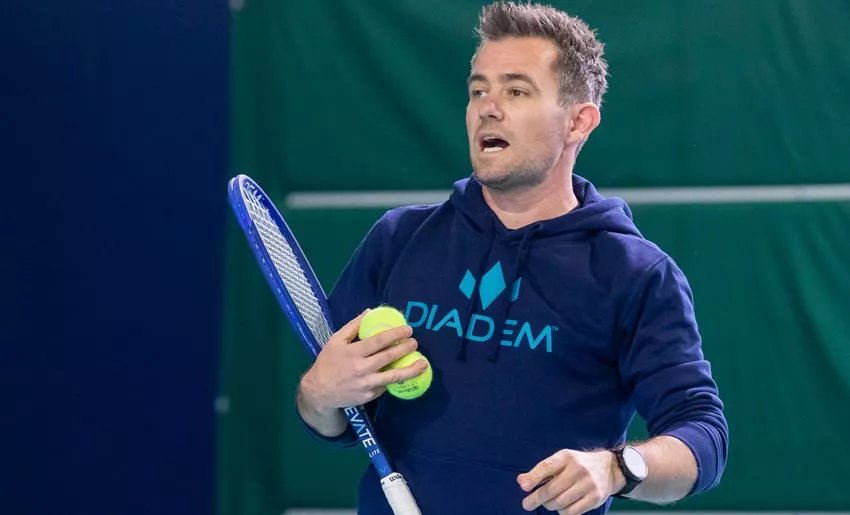
The focus here is on:
- stability under pressure
- clear between-point routines
- mental match preparation
- constructive mistake processing
In this group, mental strength often decides more than technique or fitness because performance differences are small. Structured mental training helps players access their potential in matches.
8.3 Mental Training for Tournament Players
Tournament players face competition regularly. Mental training supports them in:
- staying focused across multiple matches
- handling changing opponents and conditions
- managing mental energy deliberately
Alongside match strategies, mental recovery between matches becomes important. The goal is stable performance over a longer period.
8.4 What Professionals Do Differently — and What Recreational Players Can Learn
Pros differ less through extraordinary mental abilities than through consistency. Mental routines, pre-match preparation, and post-match review are integral parts of their daily work.
For recreational players this means:
- mental strategies must be trained regularly
- simple, clear tools are more effective than complex concepts
- mental work starts in practice — not only in matches
Next, we look at the coach’s role and how mental work can be integrated into tennis practice — ideally without extra time, but with big impact.
9. The Coach’s Role: Integrating Mental Work into Tennis Training
Mental training works best when it is consistently integrated into everyday training. Coaches play a key role: they shape conditions, set impulses, and influence players’ mindsets — often without realizing it.
What matters is not the amount of mental content, but how targeted it is embedded into existing drills.
9.1 Coaching Methods for Mental Learning in Tennis
Mental skills can be trained implicitly — embedded in technique or tactics drills.
Examples:
- task focus instead of outcome goals (e.g., “play with good net clearance” instead of “win the point”)
- pressure simulations (e.g., start every rally at 30–30)
- time or rhythm constraints to control focus
This builds mental strength not in isolation, but in real game contexts.
The 30:30 game format is well suited for practicing pressure situations in trainig.
9.2 Communication Techniques in Tennis Mental Training
A coach’s language strongly shapes mental development. Performance-supporting communication is characterized by:
- clear and especially short action cues
- descriptive rather than judgmental feedback
- focus on controllable factors
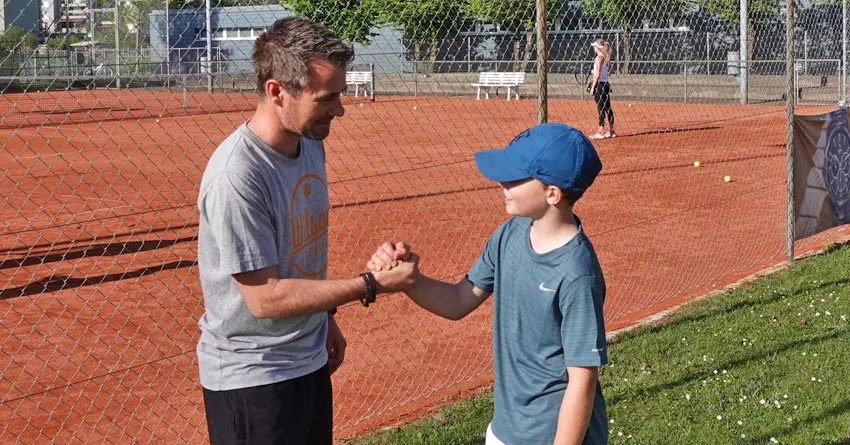
Instead of “That was bad,” “The decision was too late” supports learning. Tennis mental training begins with precise language.
9.3 Error Culture and Motivation
A constructive error culture is the basis of mental development. Players take risks when mistakes are seen as part of learning. Motivation comes not from pressure, but from clarity and orientation.
Coaches who classify errors rather than punish them promote:
- confidence
- decisiveness
- long-term mental stability
Next, we look at best practices from pro tennis and which mental strategies are successful — and how recreational players can adapt them.
10. Best Practices & Examples from Pro Tennis
At the professional level, mental strength is not an extra — it’s a non-negotiable requirement. Looking at elite tennis shows how consistently mental strategies are used and which principles can be transferred. The key is not copying pros, but understanding their logic.
10.1 Mental Routines in Pro Tennis
What stands out in top players is the consistency of their routines — on serve, return, and changeovers. The sequences are clear, repeatable, and functional. Perhaps the best-known example remains Rafael Nadal, whose between-point routines created structure, focus, and emotional stability.
Carlos Alcaraz, Jannik Sinner, and essentially all top ATP and WTA players use targeted breathing and focus strategies to manage activation and stay action-capable under pressure. Routines are not rituals for their own sake — they are mental reset tools.
Even in amateur sports, routines and rituals can be practiced during training.
10.2 Mental Coaches in Elite Tennis
At the pro level, mental support is standard. Mental coaches work on:
- attention control
- emotion regulation
- decision-making under pressure
- long-term mental development
The key point: mental work is preventive, not reactive. It is part of the training plan, not only a response after defeats.
10.3 Success Principles and Transfer to Recreational Tennis
What recreational players can learn from pro tennis:
- Simplicity beats complexity: a few clear tools used consistently
- Process focus instead of outcome thinking
- Routines over talent: mental stability comes from repetition
A good example of this mindset was Roger Federer: his calmness, clarity, and decision quality came less from emotion and more from mental order. That is achievable for recreational players too.
Next, we cover typical mistakes in tennis mental training — and how to avoid them for sustainable progress.
11. Common Mistakes in Tennis Mental Training
Mental training works sustainably only if it is implemented realistically, regularly, and in a structured way. Many players are motivated but fail due to typical thinking and execution mistakes. Knowing these is an important step toward mental strength.
11.1 Wrong Expectations About Tennis Mental Training
Some expect mental training to eliminate nervousness completely and deliver immediate results. That’s a misconception. In reality, the goal is not to avoid pressure, but to recognize it and handle it better.
Mental development is comparable to technical training:
- progress happens gradually and takes time
- setbacks are normal and must be included
- effects appear over time through consistency
Anyone viewing mental training as a quick fix will be disappointed. Anyone seeing it as a training process will benefit long term.
11.2 Irregular or Inconsistent Training
Mental skills must be trained regularly, like every stroke in tennis. Many players focus on mental training only when matches haven’t gone well for a while — which is too late.
Typical mistakes:
- mental exercises only before important matches
- no integration into daily practice
- no systematic build-up
Tennis mental training works when it becomes a fixed part of training — even during phases when things are “going well.”
11.3 Focusing on Outcomes Instead of Processes
Perhaps the biggest mistake is an excessive focus on outcomes. Outcomes are the result of many factors — not the lever for development.
A process-oriented approach:
- directs attention to controllable actions
- reduces pressure in decisive moments
- promotes consistent performance
Mental strength grows when players define success through decision quality and execution — not scores.
Next, you’ll get practical mental training exercises you can use immediately in practice and matches.

12. Practical Exercises to Apply Immediately
Mental training is effective only if it is practiced concretely. The following exercises are intentionally simple, take little time, and can be integrated directly into practice and matches. They build mental strength where it’s needed: under real conditions.
12.1 A 5-Minute Breathing Exercise for More Calm
This breathing exercise calms the nervous system quickly and reduces tension. Ideal before a match or when nervousness is high.
How it works:
- Stand or sit upright
- Inhale slowly for 4 seconds
- Exhale slowly for 6 seconds
- Focus on calm, deep breathing
Five minutes are enough to noticeably lower activation. Used regularly, this improves emotional control on court.
12.2 Visualization Exercise Before Serving
This exercise strengthens confidence and decision quality on serve, especially under pressure.
Routine:
- Pause briefly before serving
- Mentally picture target zone, rhythm (spin and speed), and ball flight
- Recall the feeling of a successful serve
This form of visualization supports automation of movement and reduces doubt — a central element of tennis mental training.
12.3 Focus Exercise Between Rallies
Between points, focus is especially vulnerable. This exercise helps you reset attention consistently.
Steps:
- Briefly look at your racket or the ball
- Take one conscious breath
- Use a clear focus word (e.g., “calm,” “clear”)
This creates a mental restart for every point.
12.4 “Reset” Technique After Mistakes
Mistakes are unavoidable in tennis; what matters is your response. This reset technique ends emotional reactions quickly.
Steps:
- Notice the mistake without judging it
- Use a short physical cue (e.g., gently rotate the racket in your hand)
- Shift focus deliberately to the next task
This prevents negative spirals and stabilizes match performance.
Next, we answer the most common questions recreational players ask about tennis mental training.
13. FAQ: Questions About Tennis Mental Training
Mental training in tennis often raises the same questions. The following answers are based on practical experience in tennis coaching. The goal is to set realistic expectations and make it easier to get started.
13.1 How long does it take for tennis mental training to work?
Mental strength does not develop overnight. With regular tennis mental training, first effects such as improved focus or calmer reactions can appear after a few weeks. Long-term stability develops over months.
What matters most:
- consistency over intensity
- integration into normal practice
- conscious application in matches
Mental training in tennis is a continuous development process — not a short-term project.
13.2 Do you need a mental coach in tennis?
A mental coach is not mandatory, but can significantly accelerate progress. Especially with recurring mental problems or stagnant performance, professional guidance helps identify individual patterns and address them specifically.
13.3 Does mental training in tennis work for beginners?
Yes. Beginners can benefit strongly because they learn early to:
- handle mistakes constructively
- focus on tasks instead of outcomes
- evaluate pressure situations realistically
Early integration creates a stable foundation for long-term development — regardless of playing level.
14. Conclusion: Why Mental Training in Tennis Makes the Difference
Mental training in tennis determines whether a player can access their potential only in practice — or also in matches. Technique, tactics, and fitness form the base; mental strength ensures these skills remain stable under pressure.
Especially for recreational players, there is huge and often unused development potential. Mental strength does not mean playing error-free or staying calm all the time, but:
- acting with focus
- processing setbacks quickly
- making clear decisions even under pressure
Anyone who treats tennis mental training as a fixed part of practice will play more consistently, more confidently, and with more control over their own game.
Mental training is not a replacement for technique and tactics — it is an amplifier that determines whether training results become visible in competition.
15. Next Steps: Your Entry into Tennis Mental Training
If you want to deepen your mental training in tennis, there are several ways to take the next step:
- Newsletter: Regular impulses and practical tips for mental strength
- E-books: Structured instructions and exercises for systematic development
- Video training: Step-by-step programs for practice and matches
- 1:1 mental coaching: Individual guidance for sustainable development
- Additional resources: Deeper content and training materials
The most important step is the first: mental strength does not come from knowledge alone, but from consistent application. Start now and take mental training as seriously as technique and tactics.
Further Resources on Tennis Mental Training
Mental training is a long-term development process. If you want to go deeper, additional structured resources can help connect theory and practice.
Recommended deep dives:
- Regular articles on mental strength in tennis
- Structured mental training plans for practice and matches
- Video analyses focused on decision-making under pressure
- Experience reports from recreational and team players
- Practical exercises to integrate into tennis practice
Further content helps you not only understand mental tools, but apply them consistently over time.

About the authorTimo Schwarzmeier is a tennis expert specializing in mental strength and tactical clarity. With over 20 years of experience as a full-time tennis coach, he holds the Swiss Tennis A Coach License and the Swiss Federal Certificate as a High-Performance Coach. His core expertise lies in competitive tennis, with a strong focus on mental and tactical training. His mission is to help ambitious players become mentally stronger and tactically sharper—winning more matches without having to train more.
The post Tennis Mental Training: Mental Strength for Better Matches first appeared on Tennistraining Online.
O que achou dessa notícia? Deixe um comentário abaixo e/ou compartilhe em suas redes sociais. Assim conseguiremos informar mais pessoas sobre o que acontece no mundo do tênis!
Esta notícia foi originalmente publicada em:
Fonte original