
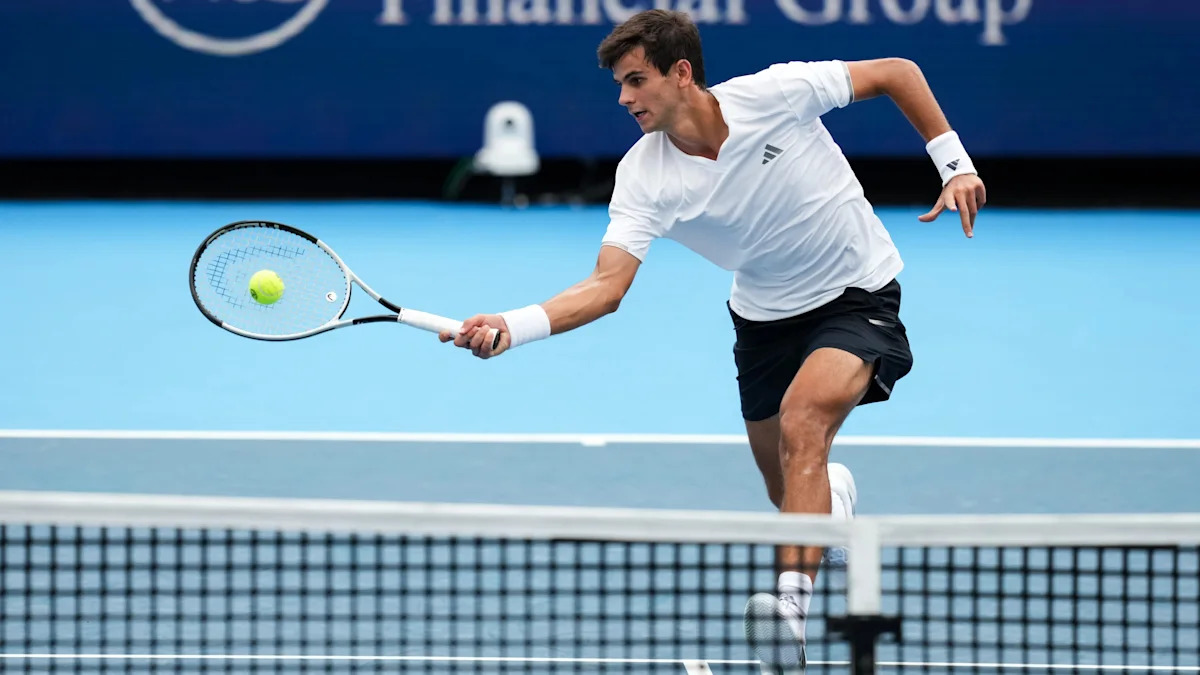
Tennis – U.S. Open – Flushing Meadows, New York, United States – September 4, 2026 Spain's Carlos Alcaraz in action during his third round match against China's Yibing Wu REUTERS/Jeenah Moon
The eight-man field for the 2026 ATP Finals is finally complete, and the numbers reveal just how differently players can qualify for the biggest event outside the Grand Slams. Alexander Zverev leads the Race with an extraordinary 9,350 points, almost three times as many as Rafael Jodar, who secured the final qualifying position with 3,234. Jannik Sinner collected 7,950 points but will miss Turin because of injury, opening the door for the Spaniard.
Some players built their seasons around amazing Grand Slam performances while others gathered points through consistency and results on Masters 1000 events and other smaller tournaments. And then there is Arthur Fils, who somehow qualified despite winning only 60 ranking points at Grand Slams.
So where did the eight qualifiers actually earn their points?
How did the eight qualifiers reach the ATP FInals?
The Established Contenders
1. Alexander Zverev — 9,350 Points
Nobody comes close to Alexander Zverev as the German collected an astonishing 6,100 points at Grand Slams, representing approximately 65% of his season total. His Roland Garros and US Open titles contributed 4,000 points alone, while the Wimbledon final added another 1,300 and his Australian Open semifinal supplied 800.
Interestingly, Zverev did not win a Masters 1000 title, although he reached the Madrid final and made several semifinals. It didn’t matter as his Grand Slam dominance was simply so overwhelming that he barely needed to.
2. Carlos Alcaraz — 5,500 Points
Carlos Alcaraz took a rather different route. The Spaniard won the Australian Open, collecting 2,000 points, but he missed Roland Garros and Wimbledon because of injury. His US Open quarterfinal added another 400. Instead, much of his remaining total came from ATP 500 events, where he collected three titles worth 1,500 points. He also earned 400 points apiece from semifinal appearances at Indian Wells and Paris.
Tennis – U.S. Open – Flushing Meadows, New York, United States – September 4, 2026 Spain’s Carlos Alcaraz in action during his third round match against China’s Yibing Wu REUTERS/Jeenah Moon
The interesting thing is that Alcaraz played only ten tournaments that contributed to his Race total. His 5,500 points show just how quickly an exceptional player can gather ranking points when he consistently reaches the latter stages.
3. Ben Shelton — 4,920 Points
Two tournaments were particularly important for Ben Shelton. His Canadian Open title contributed 1,000 points, while reaching his first Grand Slam final at the US Open added another 1,300. Together, those performances accounted for almost 47% of his total. But Shelton also won two ATP 500 titles, collecting another 1,000 points. His Australian Open quarterfinal and Paris semifinal also added 400 apiece.
Unlike Alcaraz, the American played a relatively full schedule, with 21 tournaments contributing to his final tally. It was the combination of major breakthroughs and consistent results elsewhere that secured his second consecutive ATP Finals appearance.
4. Daniil Medvedev — 3,820 Points
Daniil Medvedev is perhaps the most interesting contrast with Zverev. The Russian earned just 510 points across all four Grand Slams yet he still qualified relatively comfortably. His biggest Masters results were the Indian Wells final, worth 650 points, and semifinals in Rome and Shanghai, worth 400 each.
He also collected four titles outside the Masters and Grand Slams, including one ATP 500 and three ATP 250 tournaments. Those four trophies contributed another 1,250 points. Medvedev’s season showed that Grand Slam success is not absolutely necessary for ATP Finals qualification as winning regularly elsewhere can be enough.
The Four First-Time Qualifiers
5. Flavio Cobolli — 3,680 Points
Flavio Cobolli’s season was built around one extraordinary tournament. His Roland Garros final contributed 1,300 points, representing more than 35% of his total. The Wimbledon quarterfinal added another 400. That means nearly half his ranking points came from just two Grand Slams. Elsewhere, his Acapulco title contributed 500 points, while his Cincinnati semifinal supplied another 400.
Tennis – U.S. Open – Flushing Meadows, New York, United States – September 5, 2026 Italy’s Flavio Cobolli in action during his third round match against Belgium’s Alexander Blockx IMAGN IMAGES via Reuters/Geoff Burke
Cobolli also reached an ATP 500 final, earning 330 points. It’s pretty clear that the Italian did not dominate the calendar, but he produced several exceptionally valuable results and those were enough.
6. Arthur Fils — 3,625 Points
Arthur Fils might have the strangest qualification profile of anyone. He earned just 60 points at Grand Slams. His best major result was reaching the third round at Wimbledon, worth 50 points, while the US Open contributed another ten yet he qualified because his Masters 1000 performances were outstanding.
The Cincinnati title supplied 1,000 points, while semifinals in Miami and Madrid added 400 each. He also reached quarterfinals at Indian Wells and the Canadian Open, collecting another 400 combined.
Altogether, Masters 1000 tournaments provided 2,360 points, approximately 65% of his total. Nobody shows the importance of strong Masters performances quite like Fils.
7. Frances Tiafoe — 3,390 Points
Frances Tiafoe’s qualification for the ATP Finals depended heavily on a handful of outstanding performances. His US Open semifinal contributed 800 points, while reaching the Cincinnati final added another 650. The Halle title supplied 500, and his Acapulco final brought another 330. That is 2,280 points from four tournaments, representing approximately 67% of his total. The rest of his season was considerably less impressive.
Tiafoe struggled for consistency, particularly during the Asian swing, but his biggest results were valuable enough to compensate. His first ATP Finals qualification is therefore a reminder that a few exceptional weeks can outweigh months of relatively weak tennis.
8. Rafael Jodar — 3,234 Points
Rafael Jodar’s remarkable breakthrough season was built around his performances at Masters 1000 tournaments. Reaching the Shanghai final earned him 650 points, more than 20% of his entire total. His Canadian Open semifinal added another 400. Quarterfinal appearances in Madrid and Rome provided 200 points each. That is 1,450 points from four Masters tournaments. He also reached the Roland Garros quarterfinals, earning another 400 points.
Unlike some of the other qualifiers, Jodar had relatively little margin for error. He finished just 64 points ahead of Alex de Minaur, the first alternate. It’s an extraordinary achievement for someone who began the year ranked outside the top 150.
The Last Word
Perhaps the most interesting thing about this year’s ATP Finals field is how many different routes led to Turin. Zverev dominated the Grand Slams where Fils only collected 60 points.
Medvedev qualified through consistency and smaller titles, while Cobolli and Tiafoe relied heavily on a handful of major results. Jodar barely scraped through, while Alcaraz managed to bag enormous amounts of points despite playing a limited schedule.
There is no single formula for qualification but the statistics reveal one important truth. The ATP Finals do not necessarily reward the players who are consistently good throughout the entire season. Sometimes, they reward those who are exceptional when the points are worth the most.
Main photo credit: Aaron Doster-Imagn Images
O que achou dessa notícia? Deixe um comentário abaixo e/ou compartilhe em suas redes sociais. Assim conseguiremos informar mais pessoas sobre o que acontece no mundo do tênis!
Convidamos você a clicar em Página de Parceiros para conhecer os parceiros do Tênis Portal e acessar seus sites.
Esta notícia foi originalmente publicada em: Fonte original