

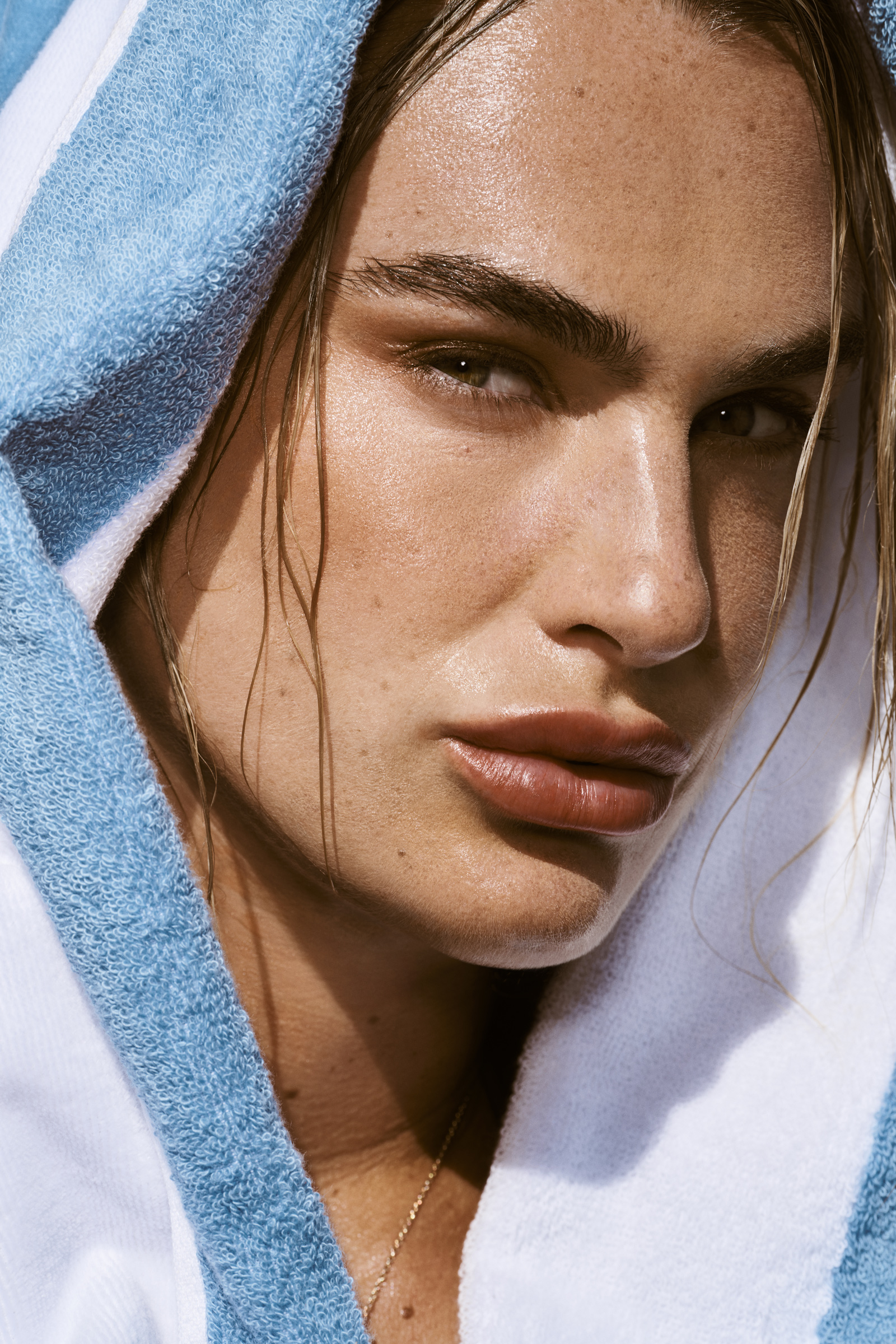
Aryna Sabalenka did not get completely drunk.
In July, Sabalenka, the world’s top-ranked women’s tennis player, lost to Naomi Osaka in their round-of-16 match at Wimbledon. It was her first straight-set defeat at a major in nearly a half-dozen years. What’s more, it was her second surprise exit in a row from a Grand Slam tournament. So when she took her place before the assembled media at her postmatch press conference, she did not mince words: “I just want to go get completely drunk,” she said, “forget about tennis and try to get better, in better shape.”
The comment created worldwide headlines, but now she is ready to set the record straight. “I had a couple of drinks,” Sabalenka tells TIME some three weeks after the loss. “I danced a little bit, I forgot about tennis for a couple days. But I never get drunk.”
After the Wimbledon disappointment, Sabalenka, 28, took a vacation to Greece, posting her leisure activities on social media as she went. She has more followers across TikTok and Instagram, 7.2 million, than any other active women’s player (aside from Serena Williams, who returned to Wimbledon at 44 but injured her knee in a first-round loss) as well as a YouTube series chronicling her life called Aryna’s Arena. The second highest paid female athlete in the world in 2025—she took in about $30 million, according to Sportico, trailing only Coco Gauff’s $31 million, and has deals with blue-chip brands like Nike, Gucci, Stella Artois, and Emirates—Sabalenka danced, sipped espresso martinis, lounged poolside, and dived off a boat into the Aegean Sea.
Some observers, however, were unimpressed. “More tennis less TikTok,” wrote one guy. What these haters don’t understand, Sabalenka explains, is that she finds posting therapeutic. “You just forget about everything,” she says. “You try to dance, try to move your body, so for just that 30, 40 minutes, sometimes an hour, it’s just being focused on one thing and not thinking about other stuff. It’s just like a small getaway.” Sabalenka rolls her eyes at the snide commentary. “Sometimes I go to their profile and see how perfect they are,” she says. “And I’m like, ‘Dude, just figure out your own sh-t before you jump into others’ lives.’”
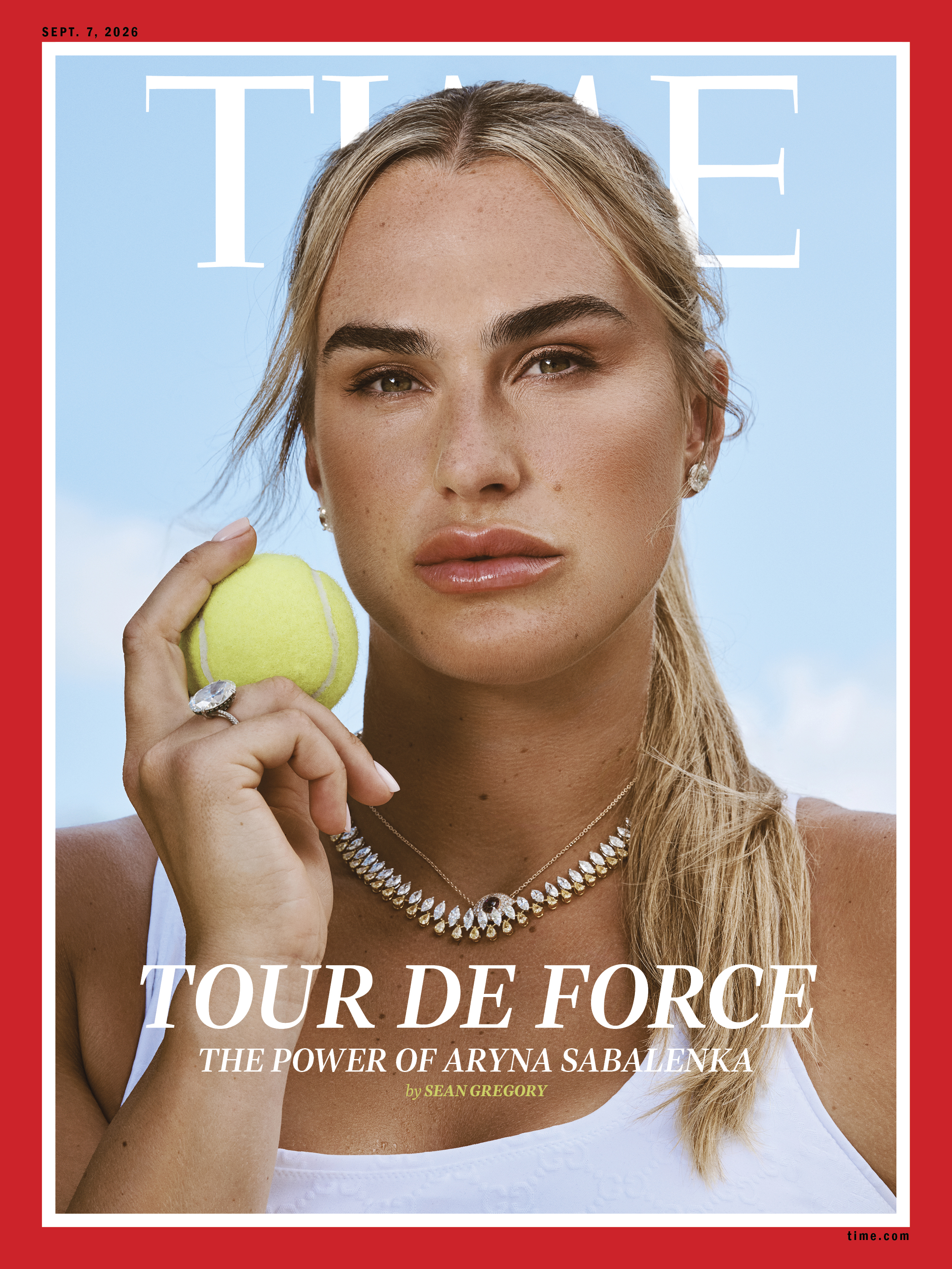
We’re speaking in a well-appointed South Florida home, replete with a tennis court and pool, not far from where she lives. And despite her detractors, Sabalenka seems relaxed and happy. Unlike at Wimbledon, where her pleas to allow dogs on the grounds went unheeded, she has her Cavalier King Charles Spaniel puppy Ash—named after Arthur Ashe Stadium, where she has won the past two U.S. Open titles—nearby. Ash is a good boy, disrupting neither the photo shoot nor our chat.
Brash, goofy, hard-hitting, unfiltered, aggressive, unafraid to lose her temper at her coach and support staff in front of a global audience—this package makes Sabalenka arguably the most compelling player in tennis. “I want to be remembered as a fighter on court, but so cool and fun off court,” she says. “I think it’s really important for kids to understand that you have to balance. You don’t have to be fully, fully focused on your dreams. One day they can destroy you.”
With the U.S. Open main draw beginning on Aug. 30, Sabalenka—who’s had to cope with personal losses and a contentious geopolitical climate on her journey to the top—remains in prime position to fulfill her wildest aspirations. She’s already one of just 10 women’s players in history to hold the top ranking for at least 100 weeks, joining the likes of Serena Williams, Steffi Graf, Martina Navratilova, and Chris Evert. “To see my name somewhere in there, it’s pretty sick,” she says.
She’s underperformed, however, at this year’s Grand Slams. At the Australian Open, Sabalenka reached the final on hard court, her best surface, but current world No. 2 Elena Rybakina mounted a comeback. With a cadre of top-ranked players knocked out of the French Open in June, Sabalenka had what looked like a clear path to her first Roland Garros title. But in the quarterfinals, she dropped 10 straight games to Diana Shnaider of Russia. Then Osaka bounced her out of Wimbledon.
If Sabalenka, a nearly 6-ft.-tall four-time major champion with one of the fastest forehands in the game, doesn’t lift the trophy in New York City, it would be the first year she’d fail to win a Slam since 2022, jeopardizing her grip not only on the world No. 1 spot, but also on the public imagination. A third straight U.S. Open victory, on the other hand, would make her nearly immortal. She’d become the first player since Williams a dozen years ago to three-peat there, and just the third woman in the modern era to do it, with Evert being the other.
“It’s history,” says Sabalenka. “You get hungrier as you go.”
Sabalenka’s independent streak has been evident since she was a child in Belarus. As the girls training in Minsk strove to follow in the footsteps of Victoria Azarenka, the country’s only singles player to claim the top spot before Sabalenka, instructors demanded strict adherence to the tactics they were teaching. But if Sabalenka had a better way, she said so. “Aryna was the one who always argued with the coaches,” says Anton Dubrov, Sabalenka’s current coach, who met her when she was 14. “She was showing who she is.”
Sabalenka’s father Sergey, a former hockey player whose own athletic career was derailed by an auto accident when he was 19, introduced his rambunctious daughter to tennis when she was 6. And while Sabalenka now embraces social media for both business and pleasure, she didn’t have much use for it as a kid; practice, school, and playing games like hide-and-seek into her teenage years occupied her time. “What’s the point of taking pictures of yourself and posting and sharing?” she says. “Who cares? That was my first thought.”
Growing up mostly off the grid, in a country with a population not much bigger than Dallas–Fort Worth’s, benefited Sabalenka. “I think that not having Instagram really helped me to focus on myself and not really get upset or depressed about not living the best life,” she says. She was blissfully ignorant of the tennis industrial complex and is thankful that she never trained at a pressure-cooker Florida academy, where many teens burn out. “It’s so much tougher here,” she says.
Still, she would be tested again and again in the early years of her career. In 2018, when Sabalenka was 20, she was named WTA Newcomer of the Year: she won two tournaments and beat top-10 opponents eight times. The next season, Sergey died unexpectedly of meningitis at 43. “We just started to get closer, like friends,” she says. “He was easy to talk to. He would be the person that would really help me to get back on track whenever things wouldn’t work well.” They had set a goal for Sabalenka to win two Grand Slam titles by the time she turned 25. That pact backfired after Sergey’s death, as Sabalenka pushed herself too hard to honor her father through Slam titles. Her mother Yulia intervened. “She said, ‘What are you talking about?’” says Sabalenka. “‘He was proud of every match you would win. Just you being able to compete on this level was huge for him.’ It really helped me to loosen up.”
But Sabalenka soon faced another problem: Russia’s invasion of Ukraine from Belarusian soil in February 2022 caused a rupture on the tour. “Some of the Ukrainian coaches, they would say really, really, really mean stuff to me,” Sabalenka says. “I don’t want to repeat it. It was so terrible. So it got to my head, and I would be hysterically crying.” Wimbledon banned Russian and Belarusian players that summer; players from those countries still don’t compete under their flags, and most Ukrainian players still refuse to shake their hands.
Sabalenka wants peace and does not support the war. “No one does,” she says. “It’s so obvious.” Does she support Belarus’ authoritarian President, Alexander Lukashenko, an ally of Russian President Vladimir Putin? “I don’t want to talk about it,” she replies.
She was already struggling with her serve before the conflict. The additional stress didn’t help. “My heart rate would go so high up, and I wouldn’t be able to breathe normally,” says Sabalenka. “I completely lost it. I had to play tennis without a serve.” She finished with 428 double faults in 2022, 151 more than any other player on tour.
“In my 50 years, I’ve seen a handful of really troubling yips on the serve,” says former player and veteran tennis analyst Pam Shriver, who reached the U.S. Open final in 1978. “Sabalenka’s was the worst. I was shaking my head, thinking, ‘Oh my God. Is this great talent ever going to recover?’”
Indeed, Sabalenka came close to quitting. “I felt like, OK, the whole world is telling me, ‘That’s it,’” she says. But before that year’s Cincinnati Open, her team called in a biomechanics expert. Within a week, Sabalenka had smoothed her motion, stabilized her balance, and in essence rebuilt her delivery. She reached the U.S. Open semis, falling to the eventual champ, Iga Swiatek. Then before the 2023 season, she made an unusual move in today’s athletic era, where mental health is paramount. She dropped her sports psychologist. “I feel like at some point I started to overthink about psychology,” she says. “I would rely a lot on that and forget about focusing on my tennis. So I decided to step away from it to learn on my own how to control myself. No one else understands myself better than me.”
This self-knowledge would prove critical as Sabalenka navigated the highs and lows of the next few years under an ever brighter spotlight. She won her first major, the 2023 Australian Open, that January. “I put my family name in history,” she says. “I wasn’t wasting my time and energy. I was doing the thing that was right for me. I am where I’m meant to be.” She reached No. 1 for the first time later that year and repeated her Australian Open victory in 2024. Sabalenka had now won two Grand Slams. At 25. Pretty much as she and Sergey dreamed. “This is something big,” she says. “It gave me so much belief inside me. I became way, way stronger.”
She’d need to call on that resilience that March when her ex-boyfriend, former NHL player Konstantin Koltsov, died of an apparent suicide. Sabalenka was preparing for the Miami Open at the time, and Dubrov and others suggested she take some time off. But Sabalenka still wanted to play. She lost in the third round, and some on social media knocked her for returning right away. “Tennis really saved me from depression,” she says. “I was just trying to focus on training, just so I spend less time with myself in my thoughts. I would cry in practice a lot. It was a very tough moment in my life.”
She began a relationship with Brazilian entrepreneur Georgios Frangulis that year. “He was really supportive and really helpful for the team,” says Dubrov. “He was always asking us, ‘What do you think, guys? Should I be at practice? Should I be at the matches?’ Sometimes relationships can be not helpful. But he was asking, ‘What do you think would be the best for her?’”
Frangulis, founder and CEO of the açaí chain Oakberry, proposed in March 2026, just a few months after Sabalenka called him out in front of a packed Brisbane International arena: “Thank you to my boyfriend. Hopefully soon I’ll call you something else, right?” Ideally, she says, they’ll get married in Greece in September 2027. She’d love to start a family at 32, then return to the tour for a few seasons before having a second child. But she brings up a version of an old Yiddish adage: Man plans, God laughs. “That’s what ideally I want,” she says. “But whatever life’s going to bring, I’m ready for it.”
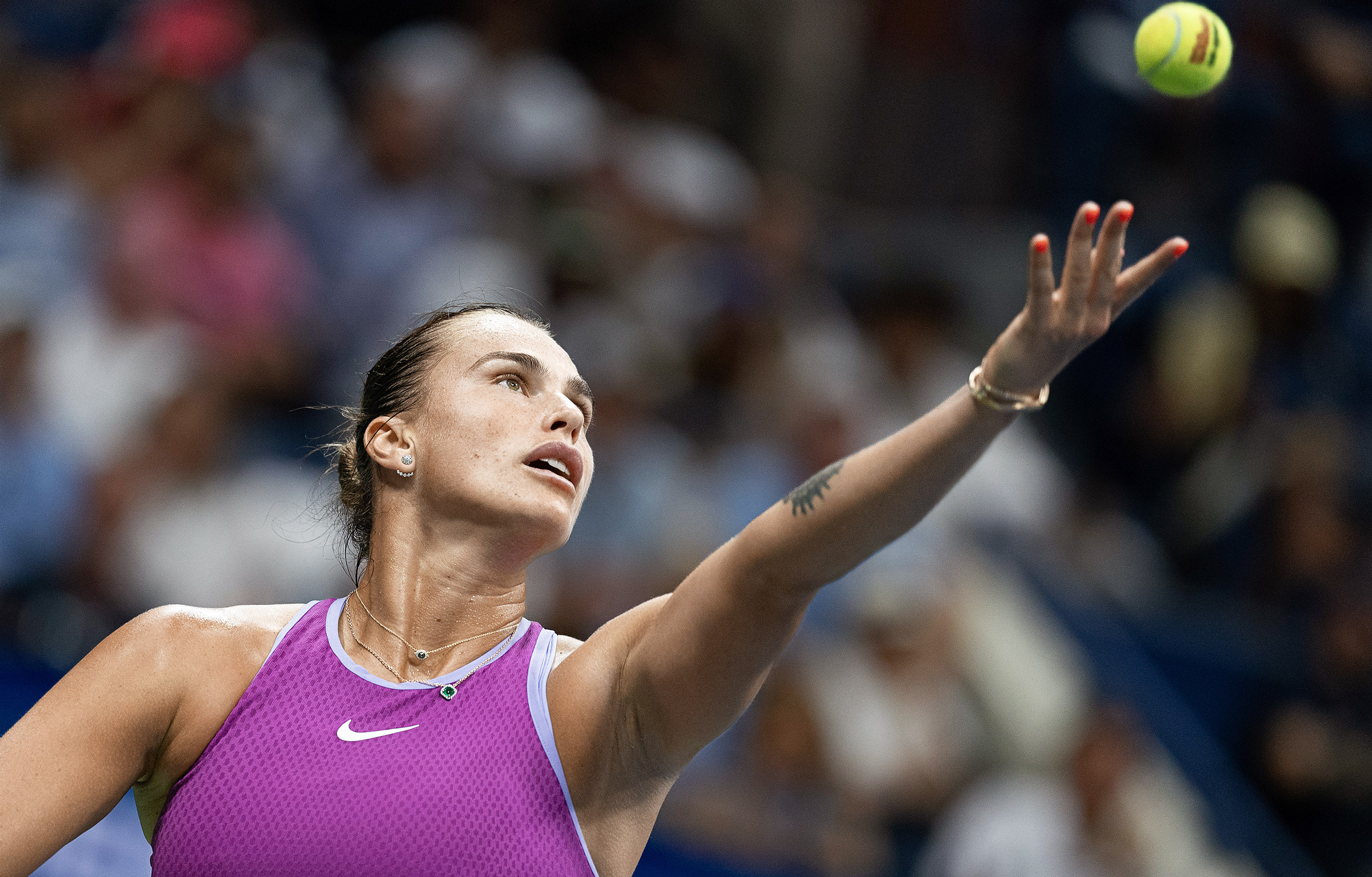
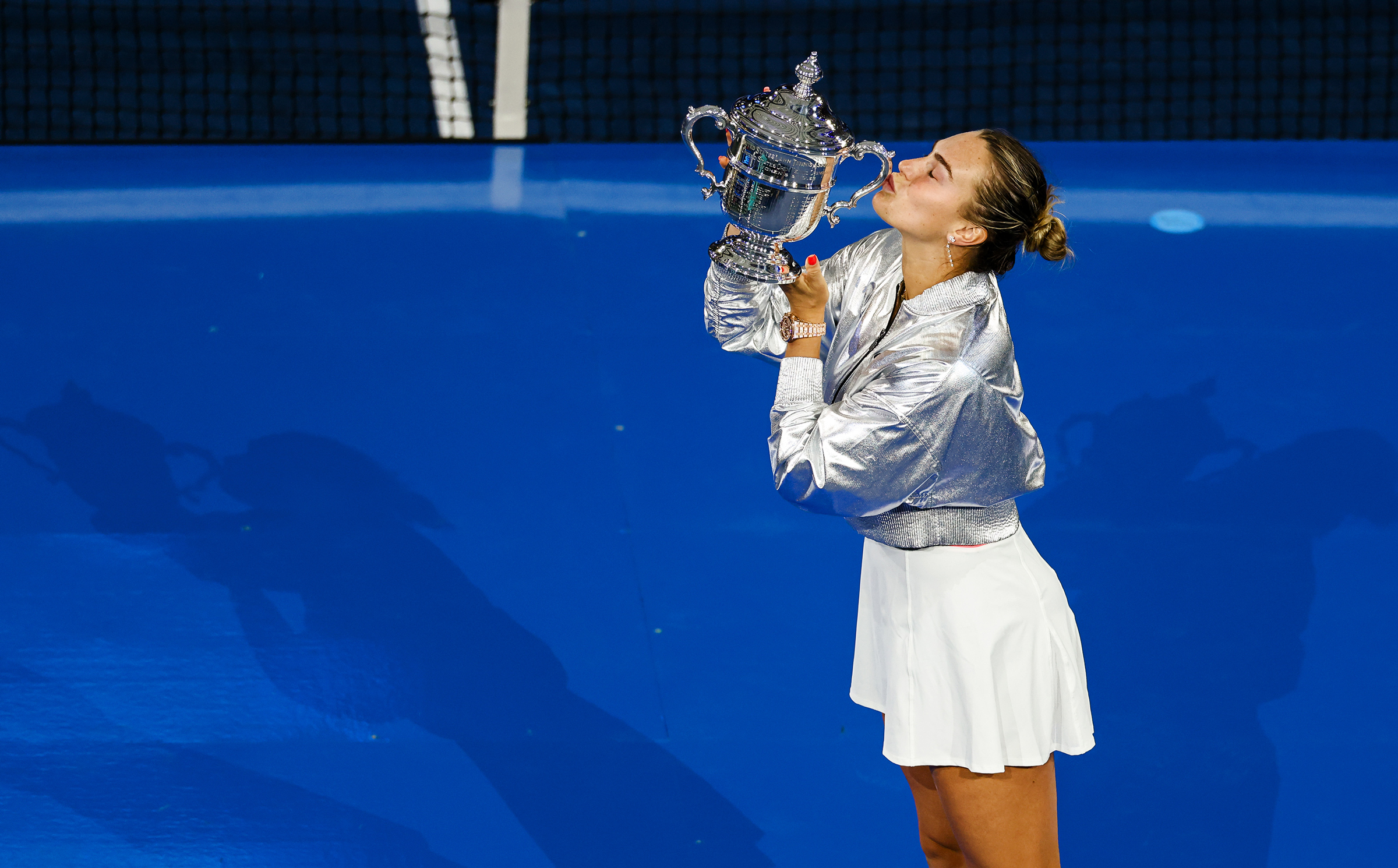
Sabalenka won her first U.S. Open in September 2024. She reached her first French Open final the following June, before crashing out against Gauff; Sabalenka committed 70 unforced errors and shouted at her box, a frequent habit when things go south. “I used to have hair, completely,” notes Dubrov.
Sometimes, a racket smash or a tantrum directed at her team can reset her game. But her rage didn’t help against Gauff. And her response to the loss ignited controversy. “She won the match not because she played incredible, just because I made all of those mistakes,” Sabalenka told reporters. The ensuing firestorm taught her a lesson. “Just shut up and wait a little bit longer before you go to the press-conference room,” she says. “Speak with your team before you actually decide to say something. Every time I lose a big match, there’s a room full of people waiting for the moment. No. Not gonna happen.”
Sabalenka apologized to Gauff for her “completely unprofessional” comment, and the pair did a fence-mending TikTok dance together at Wimbledon.
While critics focus on her meltdowns, fans, friends, and rivals appreciate that what you see is what you get. “At the end of the day, she’s a very authentic person,” says fellow pro Paula Badosa of Spain, Sabalenka’s closest friend on tour. “She always shows the way she is. That’s one of the things that makes her unique.” Even as she has acknowledged that her emotions sometimes get the better of her, Sabalenka refuses to disavow her passion. “I will never be completely in control,” she says. “When I hold that negativity inside, it keeps growing, growing, growing, growing. It destroys you from the inside to the point that you don’t have any energy and power to compete and to fight. So I’ve found it really helpful to just yell something. I have to release it.” She would love a designated racket-bludgeoning area at tournaments. “Between the sets, you just go to that room, you let it go, and you come back as a new person,” she says.
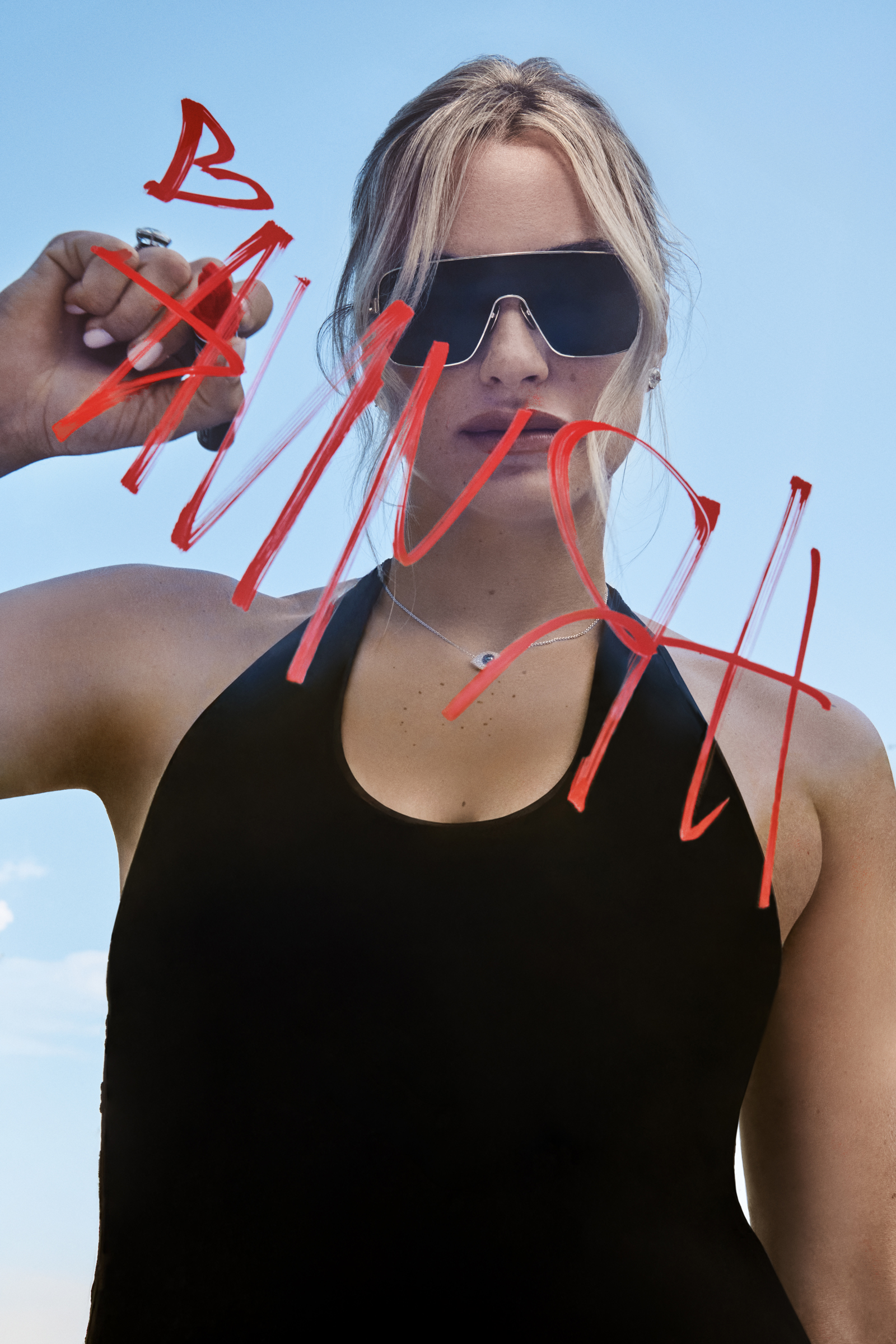
She also expresses not just rage but also joy. When Sabalenka rallied for the U.S. Open repeat last September, she tweaked her leg in the process, and her physiotherapist, Helen Murawska, scrambled to schedule an MRI. “She’s like half-limping, and then suddenly the tequila’s flowing and she’s dancing on a table,” says Murawska. “I was like, ‘I’m just going to put my blinkers on for this. Let her enjoy it.’” Sabalenka showed up to the scan: her leg was fine.
Sabalenka took a swing at something new last offseason. In December, she and Nick Kyrgios, the controversial but talented Australian player, played a “Battle of the Sexes” exhibition in Dubai. Kyrgios won, 6-3, 6-3. Critics called it a money grab beneath a champion like Sabalenka, who defends her decision, saying she wanted to bring more visibility to the sport. She says she’d do it again, but without the modified format of one serve and a smaller court on her side. And she’d want a different opponent. “Nick was so tight, so he couldn’t really bring some fun,” she says. “I would do it with someone else. He lost trust.” She declines to elaborate. (Kyrgios did not comment.)
It was ahead of her match against Kyrgios that she made her first comments about transgender athletes competing in women’s sports, saying that while she had nothing against trans people, it wouldn’t be fair. She reiterated this stance at the Canadian Open in August when asked if she supported the WTA’s new genetic sex testing policy. “It’s obvious that biologically, right, the men are way stronger than women,” she said, “so I feel like it would be not really fair for the women to compete against biological men.”
Earlier this year, Sabalenka became just the second woman in a decade to win the “Sunshine Double”—back-to-back titles at Indian Wells, in California, and the Miami Open. She couldn’t, however, carry hard-court momentum into clay season. She suffered a third-round loss at the Italian Open in May, though perhaps more notably she and other top players, like Gauff and Jannik Sinner, used the occasion to advocate for a larger share of Grand Slam tournament revenue. She mentioned the possibility of a boycott. “I hope it’ll never get to that point,” she says. “But I feel like all of the players are on the same page. If one day we have to boycott the tournament, we will definitely do that.”
After imploding again in Paris, she mused about quitting. That night, Sabalenka says, she cried “like crazy, to the point that I didn’t have any tears left. The next day I woke up swollen.”
She got over it in three days. On the relentless tennis calendar, another major always awaits. After Sabalenka’s Wimbledon defeat, and Greek island getaway, she returned to Minsk to open two clay courts at her old school. In Belarus, locals weren’t worrying about her recent performances. “My phone was so crazy,” says Yaraslav Shyla, a Minsk native who serves as Sabalenka’s hitting partner. “‘Can we meet her? I’m from this shop, can Aryna visit us?’ Close friends. Not close friends. Everyone.” During her trip, Shyla estimates, Sabalenka signed 3,000 balls and posters.
At 4 p.m. on a July afternoon, Sabalenka begins her day’s second training session in 89° heat at a private club near her home. She smashes forehands, works on volleys, takes a water break under a canopy. Sabalenka, whose tiger tattoo on her left forearm reminds her to be ferocious, returns to the court, practicing net charges and drop shots. At one point, Shyla bends over at the baseline, and Sabalenka tries to fire shots between his legs. One strikes his behind. This diversion “helps take her mind off the fatigue a little and makes the practice more fun and interesting,” says Shyla. “Or painful.”
After her French Open loss, she again started talking to her sports psychologist. Fine-tuning her mental game will be key for the three-peat. “It’s good to have someone back who knows you well, who can just say a couple things that are going to completely flip the page,” says Sabalenka. “It’s kind of like a shocking reminder. ‘Oh my God, that’s exactly the approach I should have.’”
Her vibe with New York City, where she’ll also team up for mixed doubles with Novak Djokovic, should help her chances. Sabalenka has her coffee spot, her breakfast spot, her favorite restaurant (the Polo Bar in midtown). She shops and goes for walks through Central Park. “Everyone is rushing there,” she says. “Everyone is chasing something. And you’re there chasing your own thing. You feel supermotivated. For living, probably I wouldn’t choose New York, to be honest. But going there for two, three weeks, that’s amazing.”
The Arthur Ashe Stadium crowd, always rowdy and lubricated on Honey Deuces—the Grey Goose concoction of choice—feeds off her emotion. “I love that the whole stadium, if they support you, they get loud,” says Sabalenka, who has already revealed her U.S. Open outfit, a bright orange sports bra and bike shorts under a black fishnet dress. “They go crazy. They’re just there for you. It’s the best thing on earth.” Plus, Ash will make his first trip to his namesake stadium.
If Sabalenka escapes the early-round traps, she’ll be able to bank on her experience. “She hasn’t had great results at the Slams, and that is definitely a concern,” says ESPN analyst Rennae Stubbs. “But if she starts winning matches at the U.S. Open, instead of thinking about what she hasn’t done this year, I’m sure she’ll start thinking about what she did last year.”
To her credit, Sabalenka refuses to downplay the meaning of the three-peat as most stars in her position would do. “I want it pretty badly,” she says. And she’s promising quite a show, in prime time, under the big-city lights. “Great tennis, fashion, fighting, emotions,” says Sabalenka. “Just everything you could imagine.”
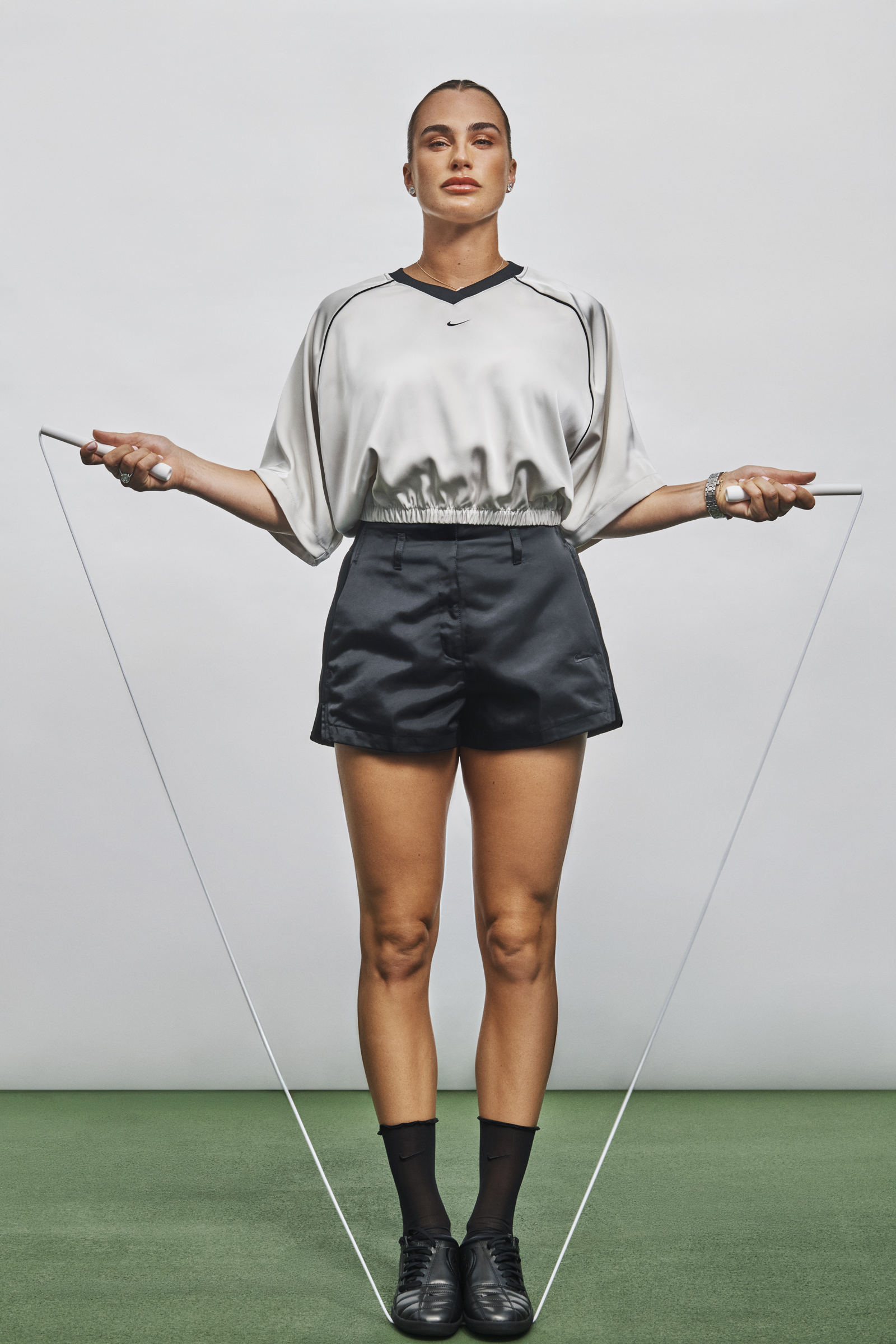
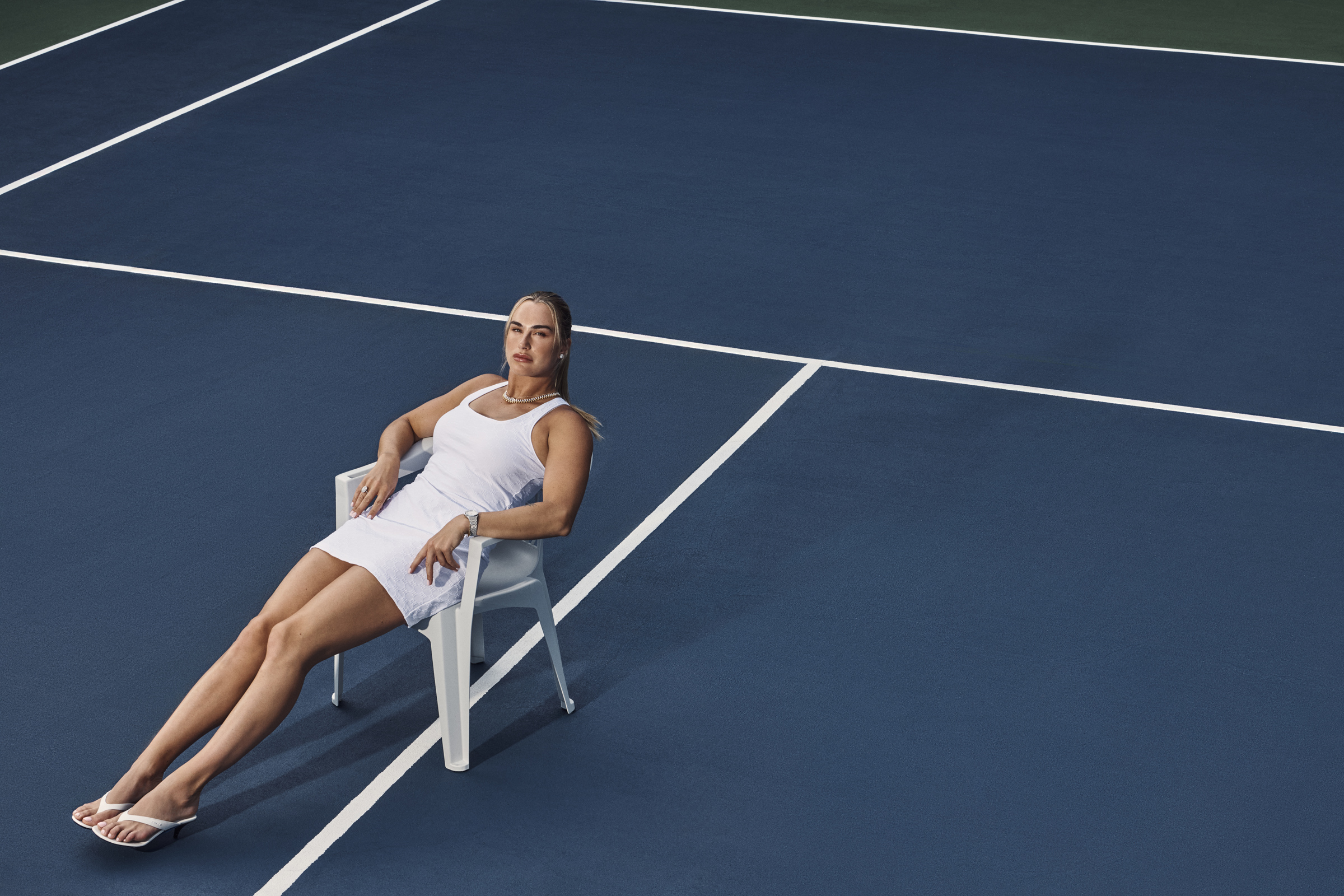
On Set Production: The Production Factory; Hair: Keshia Tabaran; Makeup: Bo Champagne; Wardrobe: Micaela Erlanger; Wardrobe credits: Jump rope photo: Top, shorts, socks, and shoes by Nike; Earrings by Material Good; Watch by Audemars Piguet; Court photo: Dress and shoes by Gucci; Earrings and necklace by Material Good; Watch by Audemars Piguet; Closing photo: Swimsuit, shoes, and sunglasses by Gucci; Earrings and bracelets by Material Good; Watch by Audemars Piguet
O que achou dessa notícia? Deixe um comentário abaixo e/ou compartilhe em suas redes sociais. Assim conseguiremos informar mais pessoas sobre o que acontece no mundo do tênis!
Convidamos você a clicar em Página de Parceiros para conhecer os parceiros do Tênis Portal e acessar seus sites.
Esta notícia foi originalmente publicada em: Fonte original